

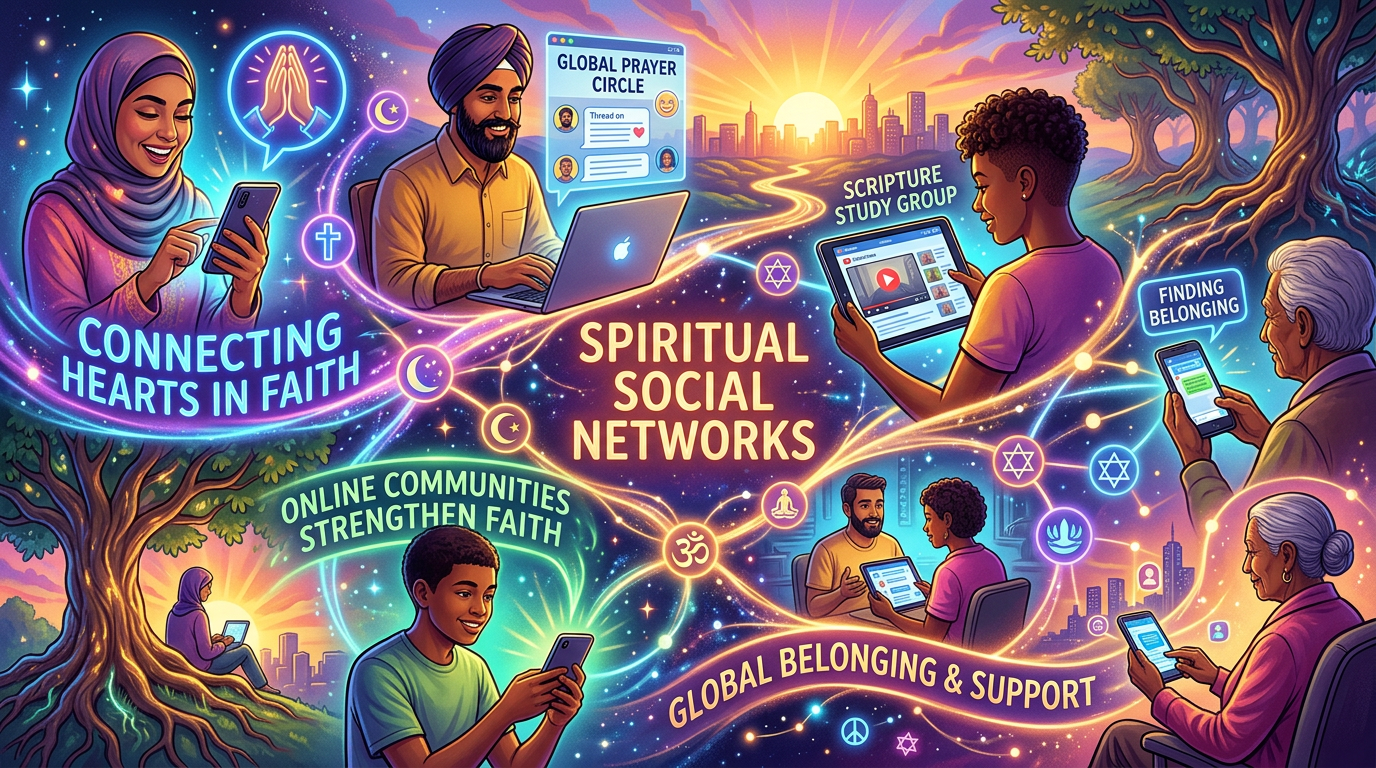
We live in a highly connected age, yet many people carry a quiet spiritual loneliness. Spiritual social networks—faith-based forums, private groups, livestream communities, discussion servers, and online study circles—offer places to speak honestly about belief, doubt, and daily life.
People often turn to these spaces when local gatherings are difficult to reach, or when they long for conversation beyond Sunday services. A late-night message can bring encouragement. A shared prayer, thoughtful discussion, or story of forgiveness can remind someone that their questions are not theirs alone.
At their best, online faith communities create belonging, learning, accountability, and compassionate dialogue. They can help us reflect on moral choices and practice love across distance and difference. Still, digital connection does not automatically replace local congregations, inherited traditions, or personal spiritual practice. Instead, these networks can become meaningful companions—bridges that support faith while inviting us back into deeper relationships, service, and reflection.
What Makes a Social Network Spiritually Meaningful?
A spiritual social network begins with a clear purpose. It may gather people around a religion, denomination, interfaith dialogue, meditation, service, or broader questions of meaning and morality. The subject matters, but so does the intention: members come not only to exchange opinions, but to seek wisdom and practice compassion.
Shared practices often give an online community its shape. These might include prayer, scripture study, meditation, guided reflection, charitable projects, or regular questions for discussion. Such rhythms turn a stream of posts into a place where people can return, participate, and grow.
Respectful moderation is equally important. Moderators help protect conversations from hostility, misinformation, and spiritual manipulation while allowing room for honest disagreement. A meaningful community does not require every member to have the same answers; it makes space for questions, uncertainty, and changing beliefs.
Privacy and dignity must remain central. People may share grief, doubt, family struggles, or experiences of discrimination. Communities that protect personal information and discourage public shaming create the trust needed for genuine openness. Careful boundaries remind us that behind every profile is a person, not simply an audience member.
This trust also depends on participation. Passive content consumption can offer encouragement, but it rarely creates belonging by itself. Members need opportunities to listen, contribute, reflect, and build relationships over time. A thoughtful response to someone’s story may become a small act of companionship.
In this sense, the strongest digital faith spaces resemble a welcoming gathering more than a religious news feed. They invite presence rather than performance. Their value grows through repeated acts of attention, forgiveness, and care, as people discover that spiritual life can be supported through connection without being reduced to a screen.
Finding Belonging, Encouragement, and Spiritual Support Online
Belonging often grows through small, repeated moments. In spiritual social networks, a daily check-in, prayer request, or reflection thread can become a steady reminder: you are not carrying life alone.
For someone living far from a congregation, that rhythm can matter deeply. It may also help people navigating disability, illness, caregiving, or limited transportation. A group that remembers a birthday, celebrates a new job, or marks a season of grief can offer spiritual companionship across the miles.
These communities can also make room for questions that feel difficult to voice in person. Distance and anonymity sometimes lower the fear of judgment. Someone may ask about doubt, guilt, grief, identity, or a moral decision and discover that others have wrestled with similar concerns.
I remember how a simple online conversation can change the shape of a lonely evening. A person shares honestly, and several others respond—not with quick answers, but with patience, prayer, and stories of their own. In that exchange, faith becomes less about having everything settled and more about seeking truth together.
For those uncertain about where they fit within a tradition, online communities can provide a gentle place to listen. People may explore different interpretations, learn from lived experiences, and recognize that spiritual growth rarely follows one straight path. Compassionate dialogue can open doors that once seemed closed.
Still, healthy boundaries matter. Online encouragement can complement trusted friendships, family relationships, local communities, and personal spiritual practice. It should not replace pastoral guidance, medical care, or mental-health support when those forms of help are needed. The wisest communities know when to offer prayer and when to encourage someone to seek care beyond the screen.
Learning, Asking Questions, and Deepening Faith Through Dialogue
Faith often grows through questions. In spiritual social networks, a reader can ask about a difficult passage, share a family tradition, or listen to someone shaped by a different history. These exchanges turn private uncertainty into an opportunity for learning and reflection.
The most helpful spaces offer structure as well as openness. Moderated scripture discussions, online book groups, question-and-answer sessions, and live lectures can give members room to explore serious ideas. Conversations with teachers, chaplains, or religious leaders may also provide guidance while leaving space for personal discernment.
Exposure to different interpretations can be humbling. We may discover that a belief we considered obvious has been understood differently across centuries, cultures, or communities. That realization need not weaken faith. Often, it helps us name our convictions more clearly and hold them with greater intellectual humility.
Disagreement can also become spiritually constructive. A thoughtful participant distinguishes sincere inquiry from deliberate provocation. Instead of trading slogans, members can explain their claims, provide context, and acknowledge what they do not know. A question such as “How do you understand this passage?” usually opens more doors than “How can anyone believe that?”
Interfaith conversations are especially valuable when they are approached with curiosity rather than competition. Hearing how another tradition speaks about forgiveness, redemption, suffering, or hope may reveal both meaningful differences and shared human concerns. These encounters can replace suspicion with understanding without requiring anyone to abandon their own identity.
Still, digital learning calls for careful judgment. Viral quotations, confident posts, and charismatic personalities are not automatically reliable authorities. Members should verify teachings, historical claims, and sacred-text references through trusted sources, including recognized scholars, established institutions, and the texts themselves. Healthy communities welcome that kind of checking because truth does not need protection from honest questions.
Turning Digital Faith Into Daily Practice and Moral Action
The deepest promise of spiritual social networks is not constant conversation. It is the quiet transformation of conversation into practice: a morning prayer, a weekly meditation, a page of sacred reading, or a renewed commitment to gratitude.
Digital tools can help make these practices easier to remember. Members might choose shared goals, receive gentle reminders, or join a seven-day reflection challenge. Group check-ins can offer encouragement when motivation fades. Yet faith is not a performance measured by completed tasks or public consistency. A missed prayer is not a moral failure, and spiritual growth rarely follows a perfect schedule.
The strongest communities use accountability to nurture honesty rather than competition. One group might invite members to reflect each evening on where they noticed compassion, resisted anger, or offered forgiveness. These reflections turn inward attention toward daily ethical decisions, including how we speak at work, treat family members, spend money, and respond to people who disagree with us.
Discussion can also become organized care. Imagine an online group studying teachings about compassion. During one conversation, a member mentions that a nearby food pantry is struggling to meet rising demand. The group could respond by collecting donations, arranging volunteer shifts, preparing meals, or offering transportation to neighbors who need assistance.
This same energy can support mutual aid, crisis response, charitable projects, and advocacy. Members may share emergency resources, accompany someone through grief, or work together on an issue rooted in their moral commitments. Prayer can remain part of that response, but it does not have to be the only response.
There is an important difference between displaying goodness and practicing it. A healthy community measures its influence by the patience, generosity, courage, and care its members carry offline—not by likes, comments, or visible declarations. Its greatest work may happen quietly, beyond the screen, where faith becomes a way of living with and for others.
Navigating Risks: Echo Chambers, Misinformation, and Spiritual Manipulation
The same connection that makes spiritual social networks meaningful can also narrow our vision. Algorithms often show us more of what we already believe, creating echo chambers where familiar voices seem like the only trustworthy ones. Over time, sectarian hostility, conspiracy content, and decontextualized religious claims can begin to feel like spiritual insight.
This process is not always dramatic. A verse may be shared without its surrounding passage, or a historical story may be presented as unquestionable proof. Healthy communities make room for context, complexity, and respectful disagreement. They encourage members to check sacred-text references and historical claims through the texts themselves, recognized scholars, and established institutions.
Manipulation becomes more concerning when belonging depends on obedience. Warning signs include demands for unquestioning loyalty, excessive financial requests, secrecy, and claims that one leader or group holds exclusive spiritual authority. Be cautious when a community attacks your outside relationships, punishes honest questions, or treats doubt as betrayal. Faith can call us toward commitment, but it should not require surrendering conscience.
The atmosphere matters, too. Harassment, pressure to conform, and public shaming can hide beneath language about accountability or holiness. Ask what happens when someone disagrees, needs a break, or makes a mistake. A community shaped by forgiveness will not confuse control with care.
Practical safeguards can help. Review a group’s moderation policies before participating, and protect personal information. Check sources rather than sharing emotionally powerful claims immediately. Maintain offline relationships with family, friends, congregations, and trusted mentors who can offer perspective beyond the platform.
Use reporting tools when harassment or dangerous content appears. Most importantly, notice what the community consistently produces in you. If it leaves you fearful, contemptuous, isolated, or unable to ask questions, leaving may be an act of wisdom rather than failure.
Digital spaces are shaped by participant behavior, platform design, leadership, and the norms a community reinforces. The goal is not suspicion toward every online gathering. It is discernment: choosing communities that strengthen compassion, humility, and freedom instead of dependence or division.
Building Healthier Online Communities for Faith
The healthiest spiritual social networks do not ask us to choose between digital connection and embodied community. They use technology wisely, making encouragement, reflection, and shared practice more accessible while directing people toward deeper relationships offline. A prayer shared online may become a phone call, a thoughtful discussion may inspire service, and a moment of forgiveness may change how we treat someone nearby.
Technology cannot manufacture spiritual depth. No platform can create humility, redemption, or love simply by gathering people in one place. Yet intentional communities can use digital tools to support these qualities through honest questions, disciplined practices, careful listening, and compassionate action.
That requires openness and discernment. We can welcome different experiences without treating every claim as equally reliable. We can verify teachings, notice unhealthy pressures, and remain willing to revise our understanding. We can also protect time for silence, worship, friendship, and service beyond the screen.
Participation carries responsibility, too. Each comment can either deepen trust or weaken it. Each leader must practice transparency and accountability. Each member can help create a culture where disagreement does not become humiliation, and where people are encouraged to seek pastoral, medical, or professional care when needed.
The future of faith online will not be shaped by technology alone. It will be shaped by the habits we bring to these spaces: openness without naivety, conviction without contempt, and connection without dependence.
A simple question can guide us: Does this community make its members more thoughtful, humane, grounded, and willing to serve? If it does, digital fellowship may become more than conversation. It may become a faithful companion to the life we are called to live together.

Leave a Reply