
Spiritual togetherness begins where private spirituality meets relationship. A quiet prayer, personal meditation, or solitary question may shape us, yet faith often grows deeper through conversation, ritual, shared service, and mutual care. Meaning becomes something we do not only hold within ourselves, but explore with others.
This does not require simple agreement. Spiritual togetherness makes room for belonging, shared questions, moral attention, and the willingness to grow alongside people whose experiences may differ from our own. A congregation may gather around familiar beliefs, while a circle of friends may find connection through compassion, wonder, or a shared commitment to justice.
Across history, people have sought strength in communal practices: breaking bread, singing, mourning, forgiving, and celebrating new beginnings. These moments remind us that redemption and hope are rarely private achievements. They are often received and renewed through the presence of others.
In this article, we will consider how faith and community create shared meaning without erasing respectful differences. Along the way, you are invited to encounter personal spiritual reflections that explore the ordinary experiences where connection becomes sacred. Perhaps spiritual togetherness is less about having every answer than learning how to ask better questions, together.
Defining Spiritual Togetherness Beyond Simple Belonging
Spiritual togetherness is more than attending the same church, mosque, synagogue, temple, or meditation group. It describes a shared orientation toward life’s deepest questions: What is sacred? What do we owe one another? How might we become more compassionate, truthful, or whole?
People can share a religious label without sharing trust. They may sit in the same sanctuary while feeling isolated, unheard, or uncertain. At the same time, people from different traditions may experience genuine unity through common compassion, a commitment to justice, or a shared hope for healing. A hospital volunteer, a prayer group, and a neighborhood mutual-aid team might express this connection in very different ways.
This kind of communion grows through participation. It develops when people listen to one another, practice care, tell stories, face suffering, and celebrate moments of grace together. Over time, these encounters create shared meaning—not because everyone interprets life identically, but because people recognize something valuable in one another’s search.
Four elements help clarify the idea:
- Shared meaning: common questions, hopes, stories, or sacred values.
- Embodied practice: rituals, service, silence, prayer, art, or daily acts of care.
- Ethical commitment: responsibility for how our beliefs shape our choices.
- A sense of belonging: the experience of being seen, welcomed, and needed.
Yet togetherness should never require surrendering individuality. Healthy spiritual community leaves room for conscience, doubt, culture, and differing interpretations. It does not demand perfect agreement. Instead, it invites us to remain present with one another, trusting that connection can deepen even when our answers—and our paths toward them—remain distinct.
How Faith Creates Shared Meaning
Faith gives communities a language for life’s deepest questions. Sacred stories, scriptures, prayers, and ceremonies help people speak about hope, suffering, gratitude, forgiveness, and responsibility. They also preserve communal memory, reminding people where they have come from and what their ancestors endured, celebrated, or sought to repair.
These traditions can shape identity without requiring identical experiences. Two people may hear the same story and draw different personal meanings from it. One may find courage in a story of deliverance, while another notices its call to humility. Spiritual togetherness grows when both interpretations can belong within a larger tradition.
Faith also becomes visible through moral practice. A belief in human dignity may lead a congregation to welcome strangers, serve neighbors, tell the truth, reconcile after conflict, or care for people who are vulnerable. In these actions, shared meaning moves beyond ideas. It becomes something people practice together, often in small and ordinary ways.
A community’s faith can offer direction during grief, uncertainty, and change. A prayer spoken beside a hospital bed, a shared meal after worship, or a yearly ceremony can connect personal experience with a wider story. These moments remind us that we do not carry every burden alone.
Still, shared faith should not be confused with unquestionable uniformity. When authority or tradition silences sincere questions, belonging can become fear rather than connection. Healthy communities make room for conscience, doubt, and honest interpretation. Their shared meaning remains alive because people can explore it together, with humility, compassion, and room for growth.
The Practices That Make Spiritual Community Real
Spiritual togetherness becomes real through repeated actions, not shared ideas alone. Communal worship, meditation, and prayer create familiar rhythms, while study helps people search for meaning together. Even when beliefs differ, these practices can teach us how to remain present.
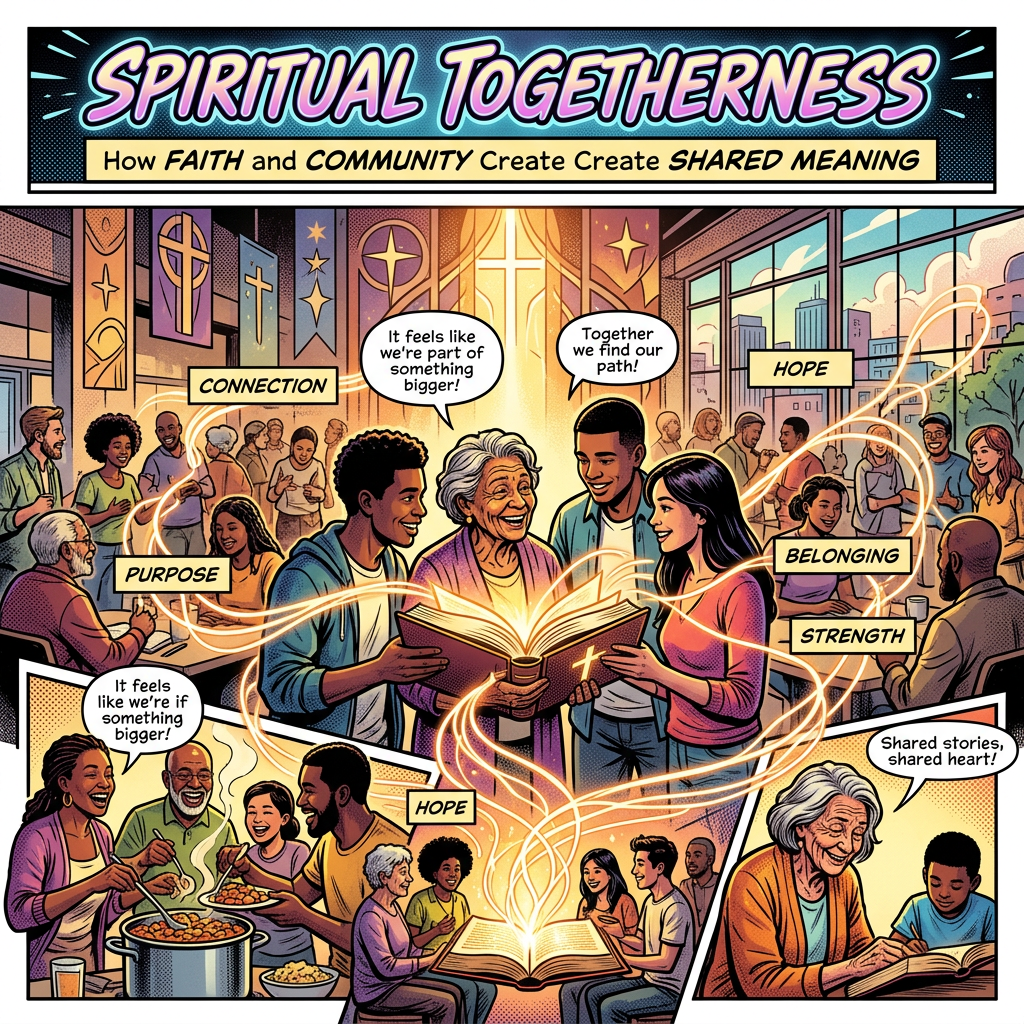
Meals often build belonging in simple ways. Around a table, people share music, stories, laughter, and sometimes silence. A song remembered from childhood or a story of faith, failure, and forgiveness can connect generations more deeply than an abstract discussion.
Listening is another essential practice. Honest spiritual conversation allows people to speak about doubt, grief, or moral conflict without performing certainty. When someone can say, “I do not know,” and still feel welcomed, trust begins to grow. Community becomes a place for truth, rather than an audience before which we must appear strong.
Mutual care gives spiritual values a human face. Members visit those who are isolated, support people in crisis, celebrate new beginnings, and mourn losses together. They also repair relationships after harm, practicing accountability, patience, forgiveness, and redemption instead of treating conflict as a reason to leave.
These habits do not belong only to formal religious institutions. A small group meeting in a living room, friends praying by a hospital bed, or a family sharing gratitude before dinner can embody spiritual togetherness. Local gatherings, neighborhood service projects, and quiet acts of welcome all create shared emotional and spiritual rhythms. Over time, such practices make community trustworthy—not because everyone agrees, but because people keep showing up for one another.
Difference, Conflict, and the Boundaries of Togetherness
Even in a caring community, difference can bring tension. People carry distinct beliefs, identities, histories, and moral convictions. Spiritual togetherness does not require us to smooth away these realities or treat every disagreement as a threat.
Healthy spiritual community makes room for honest conflict. It protects dignity, welcomes questions, and refuses coercion. People should be able to speak from conscience while remaining accountable for how their words and actions affect others. Safety matters, especially when power differences or past harm are present.
This also means distinguishing reconciliation from forced harmony. Reconciliation may begin with naming what happened, listening to those who were hurt, and seeking meaningful accountability. Sometimes it requires setting firm limits. Sometimes forgiveness can grow without restoring closeness, and sometimes a relationship cannot safely continue in its former shape.
Interfaith and pluralistic communities offer a helpful example. Jews, Christians, Muslims, Buddhists, humanists, and others may not share the same doctrines about God, salvation, or spiritual practice. Yet they can work together around concerns such as mercy, human dignity, poverty, peace, and care for the earth. Common purpose need not depend on pretending their traditions are identical.
There is danger when belonging becomes a test of loyalty. Spiritual superiority, exclusion, manipulation, and group pressure can disguise themselves as moral leadership. A community that demands silence from those who disagree may appear united, but its unity is fragile.
Mature togetherness is more honest. It asks whether everyone can participate freely, whether the vulnerable are protected, and whether love includes truth. Sometimes staying connected means continuing a difficult conversation. Sometimes it means stepping back with clarity, grief, and respect.
Why Spiritual Togetherness Matters Today
Many people today are surrounded by communication yet starved for belonging. Loneliness, institutional distrust, and algorithmic echo chambers can make sustained connection difficult. Spiritual togetherness offers a place to be known, questioned, forgiven, and welcomed without pretending that life is simple.
Digital spaces can help create that connection. An online prayer group, study circle, or testimony shared across distance may bring encouragement when local community is unavailable. Still, screens cannot replace embodied presence entirely. Sitting beside someone in grief, preparing a meal, or offering practical help gives compassion a tangible form.
Shared spiritual meaning can also move us beyond private comfort. When people believe their lives are connected, they may become more attentive to neighbors, more generous with resources, and more willing to practice peacemaking. That same conviction can inspire environmental care, civic responsibility, and solidarity across differences of culture, politics, or belief.
Yet spiritual community should not become an escape from the wider world. Its prayers and teachings must shape how people treat the vulnerable, respond to injustice, and share responsibility for their communities. Otherwise, inspiring language can conceal indifference or harm.
Discernment matters here. We can evaluate a community not only by its passionate worship or beautiful words, but by the character of its relationships. Are people free to ask questions? Are the vulnerable protected? Do members practice forgiveness, humility, and repair when trust is broken? In a divided age, genuine spiritual togetherness is recognized through patient action. It keeps showing up, making room, and turning shared meaning into love made visible.
Shared Meaning as a Practice of Belonging and Growth
Spiritual togetherness joins inner seeking with communal life. We discover meaning not only through what we believe, but through how we live, listen, forgive, and respond to one another.
It grows through openness, care, humility, and moral action. A meal shared, a difficult conversation, or a neighbor supported can make shared values visible. These ordinary practices turn belonging into something lived, not merely claimed.
The strongest spiritual communities hold conviction and humility together. They pursue a shared purpose while making room for honest difference, doubt, and growth. In that space, faith becomes less a boundary and more an invitation to deeper responsibility.
Where do you already experience meaningful belonging? And what kind of presence—patient, truthful, compassionate—can you offer others?

Leave a Reply