

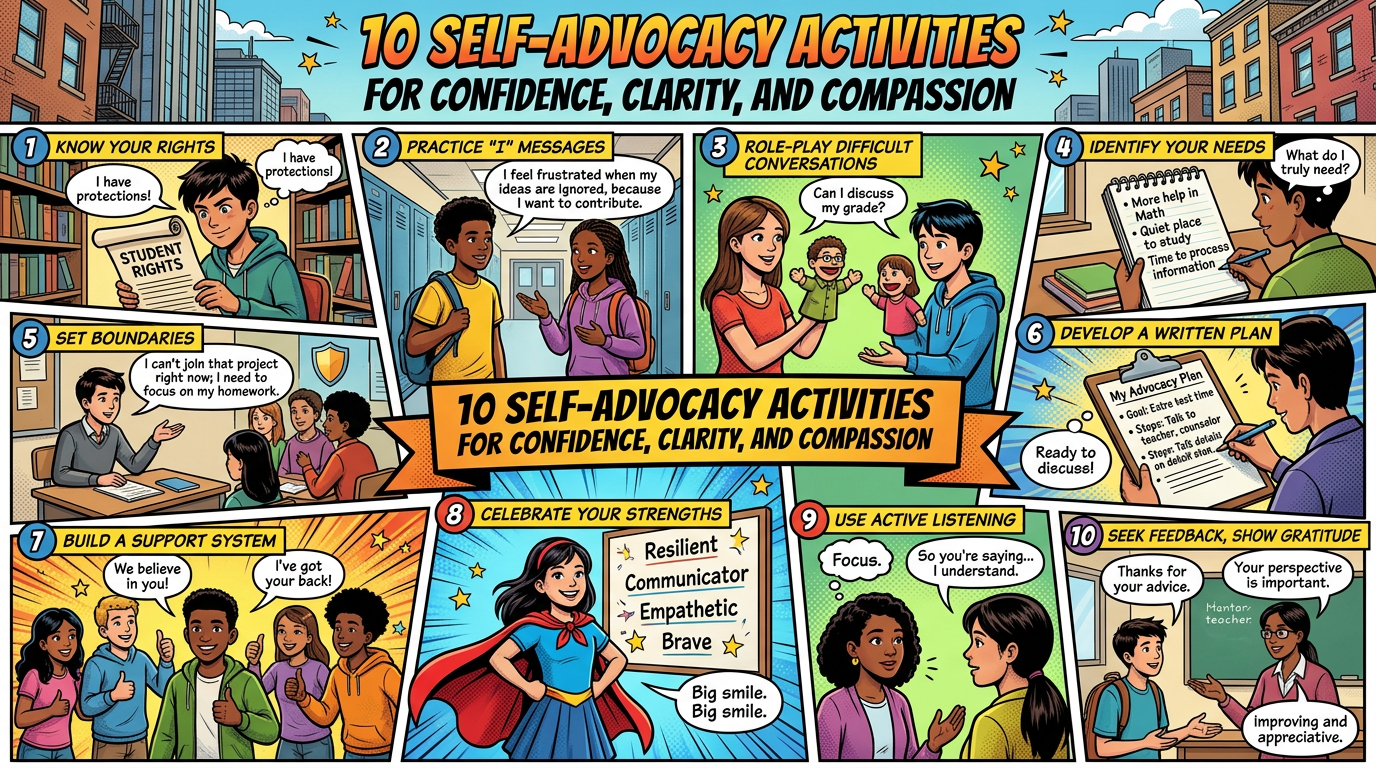
Self advocacy activities can help us speak with honesty, wisdom, and care. They are not tactics for winning arguments or controlling others. Instead, they offer compassionate ways to express our needs, make thoughtful choices, and participate more fully in relationships, communities, and faith settings.
For many people, self-advocacy feels difficult at first. Guilt, conflict avoidance, people-pleasing, spiritual authority, or fear of disappointing others may have taught us to stay quiet. Yet honoring your needs does not require ignoring anyone else’s. Confidence can grow alongside humility, clarity can be rooted in truthfulness, and compassion can respect both your dignity and the dignity of others.
The activities ahead are invitations, not rigid formulas. Choose one situation that feels manageable, then reflect prayerfully or quietly on what you need and why. Practice first in a low-risk setting, perhaps with a trusted friend or family member, and adapt the language to your beliefs, relationships, and circumstances.
As you begin, remember that setting a boundary can be an act of love. Asking for support can reflect courage rather than weakness. With patience, these practices can help you communicate more clearly while making room for forgiveness, mutual understanding, and healthier connection.
1. Name What You Need Without Apologizing for Existing
One of the most grounding self advocacy activities begins with naming what you need. When a situation leaves you tense, resentful, or unusually quiet, pause before judging yourself. Your feelings may be pointing toward a need for rest, clarity, safety, time, encouragement, or practical support.
Choose a recent situation and complete these prompts:
- I feel…
- I need…
- What would support me is…
Try to describe the situation honestly, without building a case against yourself or someone else. For example, you might write, “I feel overwhelmed when requests arrive at the last minute. I need more time to consider my responsibilities. What would support me is receiving advance notice.”
This practice also helps distinguish a core need from a passing preference. A preference might be wanting a particular restaurant. A need could be having enough quiet to recover after a demanding day. Both matter, but naming the difference can bring greater clarity to your request.
Having a need does not make you demanding, selfish, or spiritually immature. Wisdom includes noticing your limits and seeking appropriate support. Even Jesus withdrew from crowds to pray and rest, reminding us that compassion for others does not require abandoning ourselves.
When you are ready, express your need with ownership and respect. You might say, “I value this commitment, and I need more notice before agreeing to additional responsibilities.” There is no need to apologize for existing before making a reasonable request. A simple “Thank you for understanding” can replace a long explanation, leaving room for honest conversation and mutual care.
2. Create a Values-and-Boundaries Map
Self-advocacy becomes clearer when it grows from what matters most to you. Begin by naming three to five guiding values, such as honesty, rest, family, service, justice, or spiritual integrity.
For each value, write down behaviors that protect it and behaviors that undermine it. If you value rest, protecting behaviors might include turning off work notifications at night. Undermining behaviors might include accepting every request from guilt or fear.
Then translate those observations into boundaries. A boundary describes what you will do to care for your values. A preference expresses what you would like, while a punishment aims to cause pain. An attempt to control another person demands that they behave a certain way so you can feel secure.
For example, in family life, you might say, “I will not discuss private matters during an argument.” With a friend, a boundary could be, “I care about you, but I cannot respond to late-night messages every evening.” At work, you might decline unpaid tasks that consistently exceed your role.
The same wisdom applies to volunteering and religious communities. You might serve within a set schedule, or step away from conversations that shame people for asking honest questions. These choices do not reject community. They help you participate with integrity and compassion.
As self advocacy activities go, this map offers a steady place to begin. It helps you ask, “What am I protecting, and how can I express that need without condemning someone else?” Clear values can make room for both courage and forgiveness.
3. Practice the “I” Statement Conversation
An “I” statement helps you speak honestly without turning a difficult moment into a character judgment. This repeatable structure keeps the conversation grounded: “When [specific situation] happens, I feel or experience [impact]. I need [need or value], so I’m asking for [clear request].”
For example, you might say, “When plans change without telling me, I feel anxious and unprepared. I need clearer communication, so I’m asking you to text me when the schedule changes.” Notice how this describes observable behavior rather than guessing someone’s motives. It also names the impact, identifies a need, and offers a specific next step.
As you practice, avoid mind-reading phrases such as “You don’t care” or “You’re trying to embarrass me.” Exaggerated words like “always” and “never” can make people defensive. Indirect hints may feel safer, but they often leave others unsure about what you need.
Try writing one concern before speaking. Ask yourself, “What actually happened? What did I experience? What value is important here?” Then turn your answer into a clear request, such as, “Please ask before sharing my personal news.”
Truthful speech does not have to be harsh speech. In a faith-sensitive sense, speaking gently and honestly can be an expression of love, even when the conversation feels uncomfortable. It honors your dignity while leaving room for the other person’s perspective, forgiveness, and repair.
Practicing with a trusted friend can build confidence. You are not trying to control the outcome; you are learning to participate with clarity, compassion, and integrity.
4. Rehearse a Difficult Conversation with Compassion
Before entering a difficult conversation, give yourself time to prepare. Writing and practicing your words can turn anxious anticipation into a confidence-building activity. You are not creating a perfect script. You are clarifying what matters most.
Begin by writing three sentences. Name the one outcome you most need to communicate. Then write the request you want to make and the boundary you will maintain if the request is declined. For example: “I need you to understand that the criticism is hurting our relationship. I’m asking that we discuss concerns privately. If the conversation becomes insulting, I will pause and return to it later.”
Next, practice aloud in private or role-play with someone you trust. Invite them to respond with defensiveness, silence, disagreement, or an appeal to guilt. You might rehearse saying, “I hear that this is disappointing, and my answer is still no,” or, “I’m willing to continue when we can speak respectfully.”
These self advocacy activities are not about winning. They help your nervous system become familiar with using a steady voice when emotions rise. Pause between sentences, breathe slowly, and remind yourself that clarity is a form of care.
Compassion does not require absorbing another person’s anger. It does not ask you to abandon a necessary truth to keep someone comfortable. Like many lessons in forgiveness and repair, a difficult conversation may begin with honesty. You can honor the other person’s humanity while still protecting your own dignity and needs.
5. Use a Pause Before Saying Yes
Sometimes “yes” arrives before we have time to consider what we mean. In service-oriented or faith-based communities, helping can feel deeply connected to love, faithfulness, or belonging. Yet automatic agreement can leave you overwhelmed, resentful, or unable to follow through with care.
Try creating a small pause ritual before accepting a request. Take one breath, notice your body, and use a prepared response: “Let me check my schedule.” You might say, “I want to think and pray about that,” or, “I can answer tomorrow.” These simple scripts give you time without forcing an immediate explanation.
During the pause, ask yourself a few gentle questions. Do I have the capacity for this? What is motivating my answer: genuine willingness, fear, guilt, or a desire to avoid disappointing someone? Does this request align with my values, and what consequences might follow if I agree?
A delayed answer is not evasion. It can be an honest way to offer a responsible answer instead of making a resentful commitment. Consider a volunteer who is already caring for an aging parent. Saying, “I need to check what this week allows before I commit,” respects both the community and the limits of their energy.
Like other self advocacy activities, this practice strengthens clarity through repetition. You may still choose yes, but now it becomes a thoughtful consent rather than a reflex. And when you choose no, you can do so with compassion, trusting that healthy service leaves room for truth, rest, and mutual care.
6. Keep a Self-Advocacy Evidence Journal
Confidence grows when we give ourselves permission to notice it. Keep a small journal for moments when you expressed yourself, honored a boundary, asked for clarification, or recovered from a difficult interaction. This practice helps counter our tendency to remember failures more vividly than growth.
After each moment, use a simple format:
- Situation: What happened?
- What I said or did: How did I respond?
- What I feared would happen: What outcome worried me?
- What actually happened: What unfolded?
- What I learned: What might I remember next time?
Your entries do not need to describe dramatic confrontations. Asking a question during a meeting counts. Correcting a misunderstanding, declining an invitation, or requesting help also matters. These small acts are meaningful evidence that you can participate in relationships with greater clarity and care.
Try to record the choice itself, not only the outcome. A respectful request may be refused and still be a wise, courageous decision. The quality of someone else’s response does not determine the quality of your self-advocacy.
You might write, “I asked for more time before deciding. I feared disappointing them. They seemed frustrated, but I stayed calm. I learned that discomfort does not always mean I have done something wrong.” Over time, these notes become a compassionate record of growth. Among self advocacy activities, this one offers a steady reminder: redemption and change often arrive through ordinary, repeated choices.
7. Clarify Confusing Messages and Expectations
Unclear expectations can quietly turn into shame, resentment, or accidental overcommitment. This happens at work, in families, and in religious communities, especially when instructions or advice seem contradictory. Instead of silently guessing, practice asking grounded questions.
Try writing these questions in your journal or keeping them nearby:
- What specifically is being asked of me?
- What is the deadline?
- Is this required or optional?
- How will we know this is complete?
These questions are not signs of disrespect. They help you understand what you are agreeing to before offering your time, energy, or consent. Clarity also gives others an opportunity to correct assumptions and communicate more responsibly.
You might say, “I want to honor this request and support the group. Could you clarify what needs to be done, when it is due, and whether this is required or optional?” This response recognizes the authority or shared purpose of the community while honoring your responsibility to understand the commitment.
In spiritual settings, you might ask, “When you encourage me to serve more, what would that look like in practical terms?” In a family conversation, try, “Are you asking me to listen, help make a decision, or take action?” Specific questions can soften confusion without dismissing anyone’s needs.
Among self advocacy activities, this practice is especially helpful for people who fear disappointing others. You are not demanding perfect answers. You are creating enough clarity to choose honestly, serve sustainably, and leave room for mutual understanding, forgiveness, and trust.
8. Identify and Reframe the Inner Critic
Sometimes the greatest obstacle to self-advocacy is not another person. It is the quiet belief that speaking honestly makes you selfish, disloyal, rebellious, or unspiritual.
Before you advocate for yourself, pause and write the thought that appears. It might be, “If I disappoint them, I am bad,” or “A faithful person should never need rest.” Then ask: Is this belief accurate, inherited, or rooted in fear? Naming it can loosen its power.
Next, practice replacing the harsh assumption with a truthful, compassionate statement. You might write, “Disagreement does not erase love,” “Rest can support faithful service,” or “I can be accountable without accepting unfair blame.” These reframes do not excuse harmful choices. They help you respond responsibly without condemning yourself.
Consider a familiar situation. Perhaps a community leader asks you to accept another responsibility, and guilt rises immediately. Instead of assuming your refusal proves a lack of devotion, you might remind yourself, “My limits are real, and honoring them helps me serve with integrity.” That thought creates room for an honest answer.
Among self advocacy activities, this practice can feel especially tender because inner criticism often has a long history. Positive self-talk is not a cure-all, particularly when shame is deeply rooted. A trusted pastor, therapist, mentor, or supportive community may help you understand those beliefs and practice a more compassionate way forward.
With time, your inner voice can become less like a judge and more like a wise companion. That shift makes room for clarity, forgiveness, and courageous action.
9. Practice Receiving Help and Speaking Up in Community
Self-advocacy does not happen only through individual boundaries. It also grows when we name what we need and allow trustworthy people to respond. Asking for help, clarification, an accommodation, or protection is not a failure of independence. It is one way we strengthen the community we share.
Begin by identifying one area where you routinely struggle in silence. Perhaps crowded spaces overwhelm you, instructions feel unclear, or caregiving has exceeded your capacity. Write one specific request for a safe person or group: “Could you send the details in writing?” “Can someone accompany me?” or “I need to step back from this responsibility for two weeks.”
Notice what happens when you speak. Healthy community is built on mutual care, not constant obligation. People can contribute generously while also acknowledging limits, vulnerability, illness, grief, and changing capacity. Receiving support gives others permission to be human, too; it does not erase your dignity or your ability to give.
Discernment matters. Consider whether this community responds with respect, curiosity, and practical care—or with coercion, dismissal, guilt, or retaliation. A trustworthy group may not meet every request, but it will take your voice seriously and seek an honest path forward.
If a community repeatedly punishes vulnerability, you may need additional support from a mentor, counselor, advocate, or another safe network. Among self advocacy activities, this practice reminds us that interdependence can be courageous. Like forgiveness and redemption, healthy connection makes room for truth, repair, and compassionate limits.
10. Conduct a Compassionate Post-Conversation Review
After an advocacy conversation, pause before judging the outcome. Success is not measured only by whether you received the answer, support, or boundary you wanted. Ask instead: Did I communicate clearly? Did I listen without abandoning myself? Did I honor my values?
You might write a few notes while the conversation is still fresh. What helped me speak honestly? Where did I feel grounded or afraid? What would I repeat or change next time? This reflection turns an emotional moment into a chance for learning, rather than another reason for self-criticism.
Sometimes, your review will show that repair is needed. Perhaps your tone became harsh, your message was unclear, or your words sounded more final than you intended. You can acknowledge that directly: “I was sharper than I wanted to be. I’m sorry for my tone.” Then clarify the message or restate the boundary without retracting the underlying need.
For example, you might say, “I still need more notice before taking on extra responsibilities. I want to discuss that respectfully.” This kind of repair honors both honesty and relationship. It makes room for forgiveness without pretending that the original concern was wrong.
Among self advocacy activities, this practice may be the most compassionate. Confidence grows through repetition and repair, not flawless conversations or universal approval. Each review helps you become clearer, kinder, and more willing to stand with yourself while remaining open to others.
Frequently Asked Questions About Self-Advocacy
Is self-advocacy selfish?
Self-advocacy is not the same as demanding your way. Responsible self-advocacy recognizes your dignity while leaving room for other people’s needs, consent, and legitimate limits. You can say, “I need more time,” while also respecting that someone else may not be able to wait indefinitely.
How can I advocate for myself without being disrespectful?
Focus on specific behavior rather than attacking someone’s character. Try honest, measured language: “When plans change without notice, I feel overwhelmed. Could you tell me earlier next time?” Listen where possible, but remember that listening does not require surrendering a necessary boundary.
Respectful communication cannot guarantee agreement. If the other person dismisses your concern, you can calmly repeat your limit or step away from the conversation. These self advocacy activities are meant to strengthen clarity and compassion, not to make every conflict disappear.
What if saying no makes me feel guilty?
Guilt can be useful when it points to genuine harm, dishonesty, or a broken commitment. But sometimes guilt simply signals that you are challenging an old people-pleasing pattern. Ask yourself, “Did I violate a value, or did I disappoint someone by honoring my capacity?”
A kind no may still feel uncomfortable. You can care about someone deeply without accepting every request, and forgiveness does not require endless availability.
What if my faith community discourages questions or boundaries?
Faith can offer belonging, wisdom, and hope. It should not be used to excuse abuse, erase consent, or demand silence when someone is being harmed. If questions or boundaries bring threats, public shaming, isolation, or retaliation, consider speaking with a trusted person outside that community.
A therapist, mentor, advocate, or another faith leader may help you discern what is happening. Give yourself time to notice whether spiritual language is supporting your dignity or being used to control you.
What if the other person becomes angry?
You are responsible for communicating as clearly and respectfully as you can. You are not responsible for managing another person’s anger or guaranteeing a peaceful response. If someone raises their voice, threatens you, blocks your exit, or becomes intimidating, pause the conversation and prioritize safety.
You might say, “I’m willing to continue when we can speak safely,” then leave, contact someone you trust, or seek professional support. In situations involving violence, coercion, or immediate danger, contact local emergency services or a relevant crisis resource. Self-advocacy is not a universal solution; sometimes protection, distance, and outside help are the wisest next steps.
Growing in Courage, Truth, and Compassion
Self-advocacy is not a single brave conversation. It is an ongoing practice of truthful speech, wise limits, mutual care, and moral courage. Each activity offers a way to notice what matters, name what you need, and respond with integrity.
You do not need to feel fearless before taking action. Often, confidence follows the moment you speak clearly, ask for understanding, or set a reasonable boundary. A simple request for more time, support, or clarity can become a meaningful step toward trusting your own voice.
Compassion belongs in both directions. Self-advocacy protects you from self-erasure, while honest communication helps relationships become more sustainable. When you express a need without condemning another person, you create room for respect, forgiveness, repair, and mutual understanding.
Progress will not always look like perfect confidence or a conversation that goes exactly as planned. It may look like noticing discomfort sooner, explaining less, keeping a promise to yourself, or choosing support when a situation feels unsafe. Let greater clarity and integrity—not universal approval—be your measure of growth.
Choose one manageable practice from these self advocacy activities this week. Try it in one conversation, boundary, or request, then reflect on what you learned. If the situation is complex, coercive, or unsafe, you do not have to face it alone; seek support from someone trustworthy or a qualified professional.

Leave a Reply