
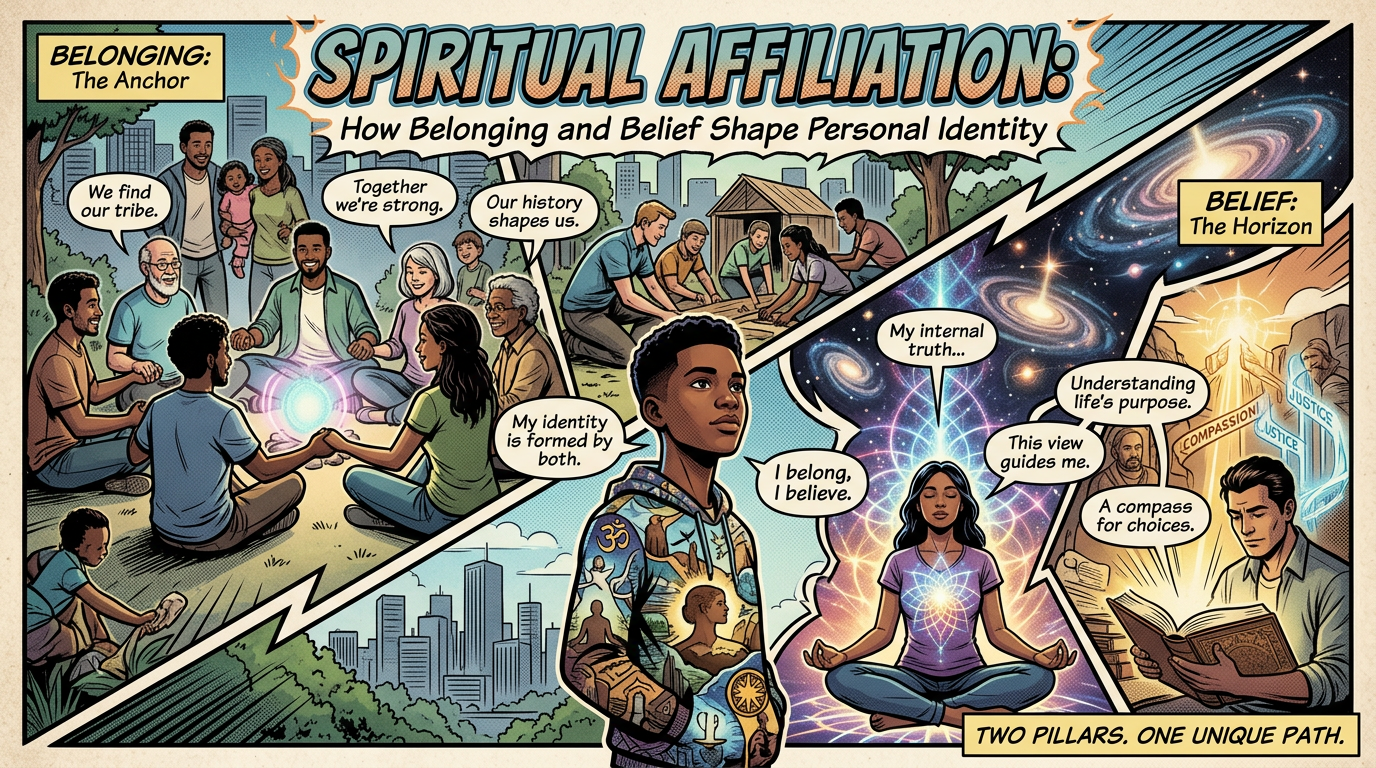
Spiritual affiliation is more than an answer to the question, “What religion are you?” It describes how a person identifies with, participates in, or relates to a religious, spiritual, philosophical, or nonreligious tradition.
For some, affiliation means deep belief and regular practice. For others, it may reflect family heritage, a familiar community, occasional participation, or an ongoing search for meaning. Someone might attend worship services without certainty, follow spiritual practices without joining a religion, or feel connected to a tradition while questioning parts of it.
Belonging, belief, and personal identity often overlap, but not always in the same way. A person may feel rooted in a community yet hold private beliefs, or intentionally describe themselves as unaffiliated. Understanding these differences helps us speak about faith with greater honesty and compassion—and recognize that spiritual identity can change across a lifetime.
Belonging and Belief Are Related but Not Identical
Belonging describes a person’s connection to a community, tradition, rituals, family history, or shared moral language. It often grows through ordinary experiences: holiday gatherings, familiar prayers, community service, or stories passed down across generations. In this sense, spiritual affiliation can express where someone feels rooted, even when their private convictions are still developing.
Belief, by contrast, concerns what a person considers true, meaningful, or spiritually persuasive. Belief may involve confidence, but it can also include doubt, uncertainty, and unanswered questions. Someone might trust in a tradition’s wisdom while still wrestling with its teachings or searching for language that fits their experience.
Consider a person who attends religious services because family and community matter deeply to them. Their participation may reflect love, loyalty, and belonging, even if they are unsure about every doctrine. Another person may identify culturally with a particular faith because it shaped their upbringing, ethics, and sense of history while remaining uncertain about its theological claims.
The opposite can also happen. A seeker may hold profound spiritual beliefs but have no formal institutional affiliation. They may pray alone, study several traditions, or find sacred meaning in nature and relationships. Their lack of membership does not necessarily indicate a lack of faith.
These examples remind us that belonging and belief often overlap, but they are not identical. Reducing spiritual affiliation to doctrinal agreement can overlook the lived reality of many people. Identity is frequently layered: communal in one setting, questioning in another, and still changing over time. Recognizing those layers allows more room for honesty, compassion, and mutual understanding.
The Many Forms Spiritual Affiliation Can Take
Spiritual affiliation can take many forms, and no single definition captures everyone’s experience. For some people, it begins with formal membership in a recognized religious institution, such as a church, mosque, synagogue, temple, or other faith community.
Formal affiliation may involve regular worship, shared observance, initiation, study, service, or participation in community life. A person might attend weekly services, celebrate sacred festivals, follow religious practices, or simply identify with an institution that has shaped their understanding of faith.
For others, affiliation is primarily cultural or inherited. Family traditions, ancestry, language, holidays, history, and neighborhood connections can create a deep sense of belonging, even when personal religious practice is limited. Someone may call themselves Jewish, Muslim, Hindu, Christian, or another identity because it connects them to family and community, whether or not they observe every tradition.
Some people describe themselves as spiritual but not religious. Their spiritual lives may be shaped by meditation, time in nature, contemplation, mystical experiences, or personal ethics. They may seek meaning, compassion, and inner transformation without belonging to a formal institution or accepting a specific set of doctrines.
Religious nonaffiliation can also be a meaningful identity. A person who chooses “none” may be questioning, exploring, or thoughtfully rejecting organized religion. This description does not necessarily signal indifference; it may reflect careful reflection about belief, belonging, and personal integrity.
Others live with uncertainty or hold an interfaith identity. They may draw wisdom from more than one tradition, participate in several communities, or feel connected to different religious histories through family and friendship. Their spiritual affiliation may change across settings and seasons of life.
These categories are not fixed boxes. One person may claim a cultural identity at home, practice meditation privately, and participate in an interfaith community with friends. Another may move from formal membership to uncertainty, or return to a tradition after years away. Such movement is not a failure of conviction; it is part of how many people discover belonging and meaning.
How Spiritual Affiliation Shapes Personal Identity
Spiritual affiliation can become part of the story people tell about who they are. It may shape how they understand compassion, responsibility, justice, forgiveness, human dignity, and the good life. These ideas often guide everyday choices, from how someone treats a neighbor to how they respond when facing moral conflict.
Identity also grows through visible and repeated practices. Rituals, clothing, dietary choices, sacred texts, holidays, prayer, meditation, and communal service can express belonging. They may connect a person to family history while offering a steady rhythm in changing seasons of life.
For many people, spiritual affiliation provides language for experiences that are difficult to name. Grief may be held through prayer or remembrance. Gratitude may find expression in worship, song, or shared meals. Questions about suffering, vocation, family life, and responsibility may be explored through stories and teachings passed down across generations.
I have seen this in ordinary conversations. Someone may describe caring for an aging parent as both a family duty and a spiritual calling. Another may understand forgiveness not as forgetting harm, but as choosing a path beyond resentment. In these moments, belief becomes less an abstract idea than a way of interpreting life.
Still, spiritual affiliation is only one layer of identity. It interacts with culture, ethnicity, nationality, gender, family background, and personal history. A person’s faith may influence these parts of life, but it does not erase them or explain everything about an individual.
Affiliation can also offer continuity and create tension. A holiday, prayer, or community tradition may provide comfort and a sense of home. Yet personal convictions may differ from family expectations or communal teachings. Navigating that distance can be painful, but it can also lead to greater honesty, empathy, and a more mature understanding of belonging.
Affiliation Can Change Through Questioning and Experience
Spiritual development is rarely a straight path. Education may introduce new ideas, while relationships, migration, grief, or major life events may reshape familiar beliefs. Exposure to other traditions can also reveal practices and perspectives that feel meaningful.
Questioning does not automatically signal failure or rejection. Sometimes it leads to renewed commitment, as a person explores difficult questions and returns with a deeper understanding. At other times, ethical disagreement or personal experience may prompt a denominational change, a blended practice, or a decision to leave a former community.
These changes do not follow one predictable pattern. Someone may move from certainty to uncertainty, then toward a renewed faith. Another person may combine inherited rituals with meditation, prayer, or teachings from another tradition. Someone else may practice privately, identify as agnostic or atheist, or remain unsure for many years.
Personal spiritual experiences can influence these choices, too. A moment of wonder, an encounter with suffering, or a sense of connection may strengthen a person’s spiritual affiliation. It may also lead them to reconsider the language and institutions that once shaped their identity.
Even when formal affiliation changes, earlier influences often remain. A person might no longer belong to a childhood religion but still observe its holidays, carry its stories, or follow its moral commitments. These elements can become part of a wider, more layered identity.
For some, questioning brings freedom. For others, departure involves grief, conflict, or the loss of familiar community. Both commitment and change deserve respect. Listening without judgment allows people to describe their journeys honestly, without treating doubt as disloyalty or certainty as naïveté.
Why Understanding Affiliation Matters in Conversations About Faith
Understanding spiritual affiliation can change the way we meet one another. In families, workplaces, and communities, a religious label rarely tells the whole story. It may describe deep belief, cultural roots, occasional practice, personal exploration, or no connection at all.
Instead of assuming, we can ask open questions: “What does that tradition mean to you?” or “How does your affiliation shape your life?” Such questions leave room for complexity. They also show that we are interested in a person’s experience, not merely in placing them into a category.
There is an important difference between describing our own convictions and treating another person’s identity as a problem to debate. We may explain why a belief guides our choices. But another person’s affiliation is not an invitation to correct, test, or defend them. Understanding does not require agreement; it requires attention, humility, and a willingness to listen.
Careful language can also reduce stereotypes. A highly observant person may still hold questions. Someone culturally affiliated with a tradition may not practice its teachings. A spiritually eclectic person may draw wisdom from several sources, while an unaffiliated person may possess strong moral commitments. These descriptions should open conversation, not limit it.
Respectful dialogue becomes especially meaningful when people recognize shared moral concerns. Compassion, justice, honesty, human rights, and care for neighbors can bring people together across significant differences. History offers many examples of religious and secular communities cooperating for the common good, even when their ultimate beliefs diverged.
In public life, this kind of care protects dignity. It helps families discuss changing beliefs, coworkers navigate differences, and neighbors resist suspicion. When we make room for each person’s story, spiritual affiliation becomes a starting point for relationship rather than a reason for division.
Spiritual Affiliation as a Lived and Evolving Identity
Spiritual affiliation is not always a single, fixed category. It may describe a relationship to a community, tradition, practice, belief, or personal sense of meaning. Belonging and belief can overlap, but they do not always match.
For some people, sincere faith shapes daily life. For others, cultural connection, private practice, spiritual exploration, or honest doubt carries greater meaning. Nonaffiliation can also express a thoughtful identity rather than an absence of values or purpose.
These relationships may change with age, experience, family life, or loss. Someone may return to a tradition, reinterpret inherited beliefs, or find belonging beyond formal religion. Such changes are not necessarily failures; they can reflect growth and deeper self-understanding.
To understand spiritual identity, we must look beyond labels and listen for lived experience. When conversations about faith and morality begin with curiosity, we make room for complexity, compassion, and connection.

Leave a Reply