

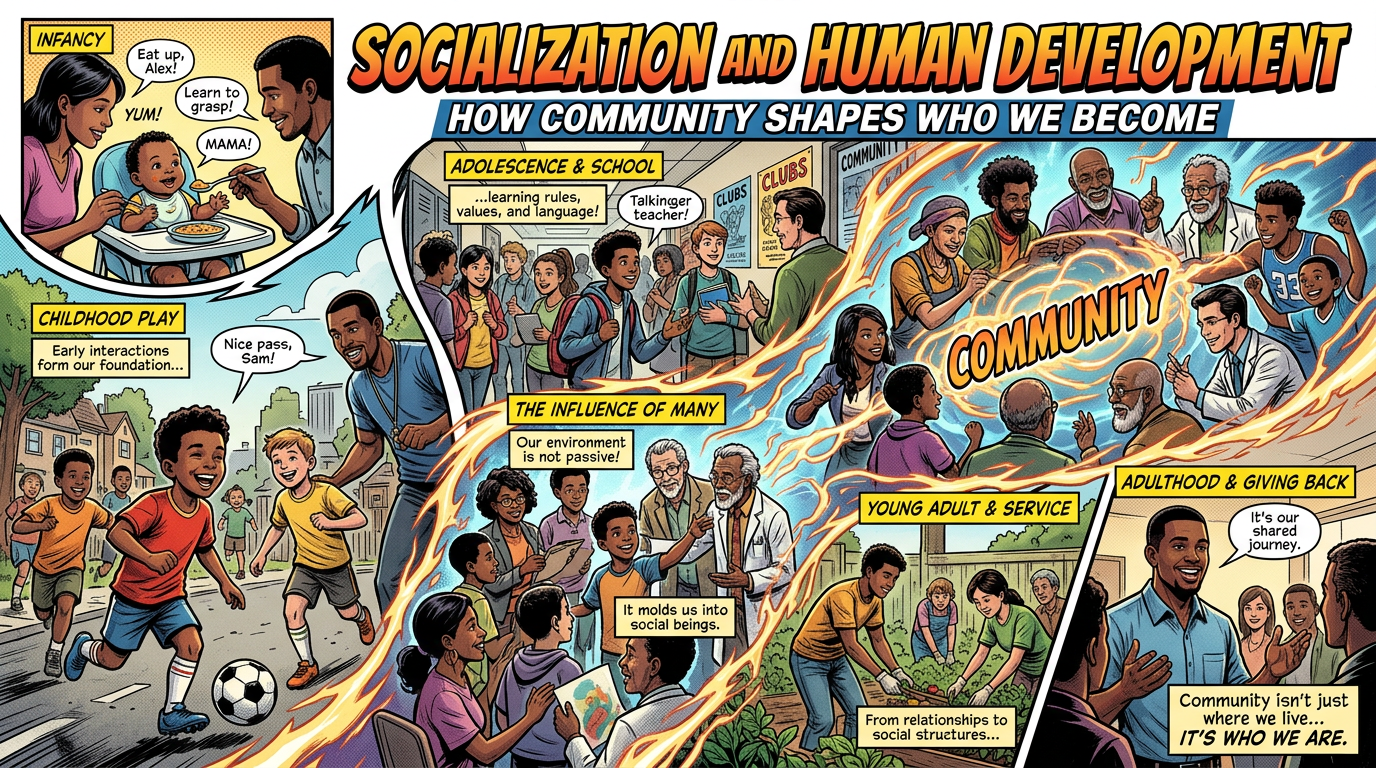
Socialization and human development begin with a simple truth: no person becomes themselves in isolation. From our earliest days, family, faith communities, schools, friendships, and wider culture teach us how to understand the world and our place within it.
These influences shape our values, beliefs, habits, and ways of relating to others. A child who is welcomed into a caring community may learn trust, compassion, and responsibility. Yet communities can also pass down fear, exclusion, or unhealthy expectations, sometimes without recognizing the harm they cause.
Most of us can remember a person or group that helped us grow. Perhaps a teacher offered patient encouragement, a congregation made room for questions, or a friend showed forgiveness when we needed it most. Such moments remind us that belonging is not passive. It forms us, even as our presence helps form others.
This raises an important question: how can communities create people who are deeply rooted, yet still capable of growth and self-examination? Exploring that question invites us to consider not only how society shapes identity, but also our spiritual and moral responsibility to one another.
The Foundations of Socialization: How We First Learn to Be Human
Long before children can explain their beliefs, they are learning what it means to belong. Through caregivers, siblings, and daily routines, they begin to understand whether the world is trustworthy and whether their presence matters.
A parent who listens patiently teaches more than good communication. A family that apologizes after conflict offers a living lesson in forgiveness and redemption. In these ordinary moments, children form early ideas about love, authority, responsibility, and personal worth.
Family traditions also give shape to a child’s moral and spiritual imagination. Shared meals, holiday rituals, prayer, service, or stories of faith can communicate what a community values. Yet children learn through observation and participation as much as through direct instruction.
They notice how adults treat strangers, the elderly, and those who are vulnerable. They watch whether authority is exercised with fairness or fear, and whether disagreement leads to understanding or contempt. Even silence can teach a lesson about whose voices deserve attention.
These experiences become part of socialization and human development. A child who encounters steady care is more likely to develop empathy, a growing conscience, and confidence in relationships. Security does not remove life’s difficulties, but it gives children a foundation for facing them without losing hope.
This foundation also shapes how they approach spiritual questions. When caregivers welcome honest doubt and model humility, children learn that faith can include curiosity, struggle, and growth. They become more willing to ask what is right, how forgiveness is possible, and how their lives might serve others.
In this way, community begins shaping identity before conscious evaluation begins. We first learn humanity through the people who hold us, guide us, correct us, and invite us into belonging.
Community as a School of Values, Identity, and Belonging
Communities teach us more than rules. They give us stories about where we come from, what we owe one another, and what kind of life is worth pursuing. Through these shared narratives, people begin to understand their place in a larger human story.
Faith communities often make these lessons tangible. Prayer, worship, religious observance, and storytelling turn abstract beliefs into lived habits. A teaching about compassion becomes a meal shared with a neighbor. A lesson about forgiveness becomes the difficult choice to repair a wounded relationship.
Rituals also give values a steady rhythm. Gathering each week, welcoming newcomers, caring for children, visiting the sick, and serving those in need communicate that love is not merely an idea. It is something practiced with our time, attention, and bodies. In this way, socialization and human development unfold through repeated acts of care.
Fellowship and accountability deepen that formation. Friends remind us who we hope to become, while trusted mentors challenge our pride and encourage our growth. Healthy communities provide roots without demanding that people surrender conscience or individuality. They offer identity as a gift, not a prison.
This balance can be difficult. Belonging may bring comfort, but it can also create pressure to conform. A mature community makes room for honest questions, personal discernment, and changing understanding. It preserves shared commitments while recognizing that each person’s journey includes struggle, doubt, and discovery.
Most importantly, belonging carries a moral message about who is worthy of care. The spiritual health of a community can be seen in how it welcomes outsiders, treats the vulnerable, and responds to those who do not fit familiar expectations. Hospitality is not an ornament added to communal life; it reveals whether the community’s values have truly taken root.
The People Around Us: Relationships, Imitation, and Moral Growth
The people around us continue shaping who we become long after childhood. During adolescence, friends often influence our language, clothing, habits, and ideas about belonging. In adulthood, colleagues, neighbors, partners, mentors, and faith communities continue that work. Socialization and human development unfold through repeated relationships, not isolated decisions.
We learn by watching what others do and noticing what receives approval. A teenager may imitate a friend’s sarcasm because it earns laughter. An employee may adopt a workplace’s impatience because it appears rewarded. Over time, people absorb behaviors, attitudes, and emotional responses that seem accepted within their group. We often become like the communities we repeatedly participate in.
Yet influence is not always unconscious or harmful. Mentors and moral exemplars show us that another way of living is possible. A teacher who admits mistakes can make humility credible. A neighbor who serves quietly can make generosity feel ordinary. Someone who speaks truth with courage, or keeps promises when it costs them, gives integrity a human face.
Many of us can name such a person. Perhaps it was a coach who saw potential before we did, or an elder who offered forgiveness without excusing harm. Their example can awaken moral imagination. They help us believe that character is not merely an ideal, but something practiced through daily choices.
Healthy relationships also challenge us. Accountability is a constructive form of love when it names harmful patterns without destroying a person’s dignity. A trusted friend may say, “You are becoming harsh,” while still leaving room for repentance and change. Such honesty can be painful, but it protects us from confusing comfort with growth.
In this sense, community does more than affirm identity. It invites maturity. Through friendship, correction, imitation, and forgiveness, we learn not only who we are becoming, but whom our lives are shaping in return.
When Community Harms: Conformity, Exclusion, and the Need for Discernment
Community can nurture us, but belonging can also become a powerful pressure. Many people tolerate harmful beliefs or behaviors because they fear losing family, friendships, or spiritual identity. When questioning a leader or group custom is labeled disloyal, silence may begin to feel like faithfulness.
Healthy moral formation welcomes honest questions and teaches responsibility without destroying dignity. Harmful communities often rely on shame, coercion, scapegoating, or rigid boundaries between the “worthy” and the “unworthy.” A child who is corrected with patience may learn wisdom; a child who is constantly humiliated may learn only to hide.
We can see this pattern in religious groups, schools, workplaces, and even close-knit families. A community may praise unity while quietly excluding those who disagree, need help, or carry a different history. Over time, socialization and human development can shape people toward prejudice when suspicion is repeated and compassion is reserved for insiders.
Discernment, then, is both spiritual and ethical. It asks whether our shared practices reflect compassion, truth, justice, and humility. It also asks whether they honor the inherent worth of every person, including those with less power and those who cannot safely speak.
This does not mean rejecting every tradition or treating commitment as oppression. Faithful belonging can include loyalty, correction, and shared responsibilities. But it must leave room for conscience, repentance, and growth. A healthy community can receive difficult truth without punishing the person who brings it forward.
Building Communities That Help People Flourish
Communities that support maturity hold clear moral convictions with humility. They know truth matters, yet they also make room for questions, honest disagreement, learning, and transformation. Such communities do not confuse certainty with superiority. They welcome the possibility that forgiveness and redemption may change everyone involved.
Flourishing grows through ordinary practices. Children benefit from relationships with elders, while older adults receive purpose through mentoring and shared life. Neighbors become stronger when they serve together, care for vulnerable people, and invite everyone into meaningful participation rather than passive attendance. These habits make socialization and human development a shared responsibility.
Healthy communities also treat conflict as an opportunity for restoration. Instead of quickly shaming or excluding people, they seek truth, accountability, repair, and renewed trust. This approach does not ignore harm. It recognizes that people can take responsibility and still be offered a path toward healing.
The goal is not conformity for its own sake. A faithful community helps people develop the courage and wisdom to live their convictions for the good of others. Through practice, encouragement, and patient correction, people become more compassionate, responsible, resilient, and open to growth.
Becoming the Kind of Community That Forms Human Beings Well
Socialization and human development remind us that no community is spiritually or morally neutral. Over time, our relationships teach us where to place attention, how to practice compassion, when to show courage, and why responsibility matters. We are shaped by communities, yet we also help shape them through everyday choices.
So we might ask: What have our communities formed in us, and what are we forming in others? Let us seek communities that deepen love of God and neighbor, while practicing truth, mercy, accountability, and hope. A life of faith grows through ordinary acts of welcome, integrity, and service—becoming a formative presence for those around us.

Leave a Reply