

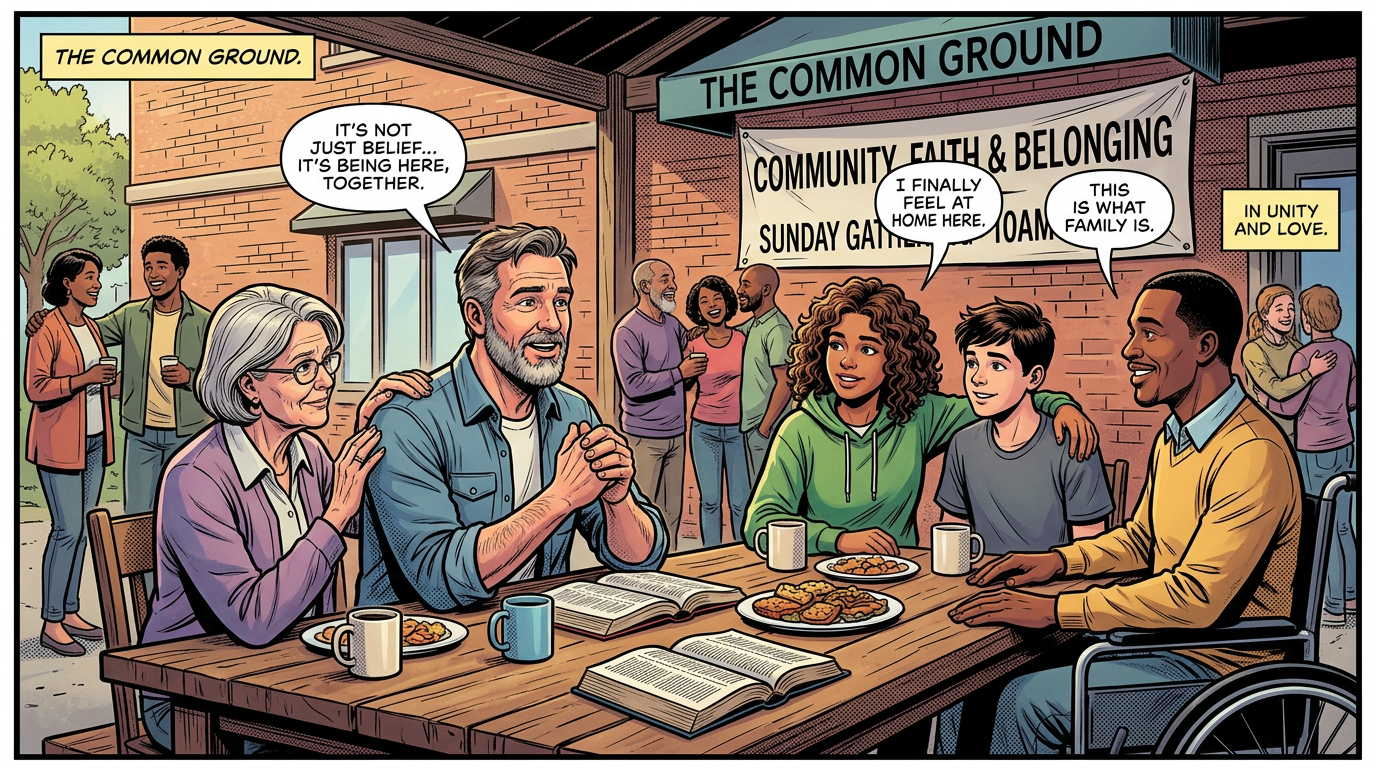
“Spirit and company” speak to two dimensions of faith that are easy to separate but difficult to live apart. Spirit may describe our inner life, a sense of divine presence, the courage to continue, or even the atmosphere shared by a group. Company may mean companionship, fellowship, or the gathered community that helps faith take shape.
Many of us value private moments of prayer, doubt, and conviction. Yet belief also grows through relationships—with people who listen, challenge us, forgive us, and remind us that we are not alone. A quiet faith can offer strength, but supportive community gives that strength a place to be tested and practiced.
This creates a meaningful tension. We need room for individual experience, while also accepting the accountability that comes with belonging. History is filled with communities that found courage and compassion together, though it also reminds us how easily unity can become control.
The question, then, is not whether faith should be personal or communal. It is how communities can create belonging without erasing individuality, and how individuals can pursue conviction without turning away from responsibility. In that space, spirit and company become invitations to live with greater connection, humility, and hope.
Spirit Begins with the Inner Life of Faith
If company describes the people who walk with us, spirit begins in the inward life we carry. It includes our convictions, hopes, conscience, and sense of meaning. Through this inner life, we ask what we believe about God, morality, suffering, and our daily responsibilities.
Spiritual growth is more than adopting a religious identity or attending familiar services. It asks us to reflect on our motives and remain open to transformation. A person may follow every routine and still avoid the deeper work of forgiveness, humility, or redemption.
This work is often quiet. It may happen when we question an old belief, notice our fear, or admit that we have caused harm. Such moments can feel uncomfortable, but they give faith room to become honest and mature.
Mature spiritual depth should not be confused with emotional intensity. A moving song or powerful experience can awaken belief, but feelings naturally change. Faith may remain meaningful through doubt, silence, uncertainty, or seasons when God seems distant.
I have known people whose faith appeared steady, not because they always felt certain, but because they continued seeking truth with patience. Their questions did not erase their commitment. Instead, uncertainty taught them to listen more carefully and judge others less quickly.
The inner spirit also shapes how we live with other people. It influences whether we respond to conflict with revenge or restraint, and whether another person’s need becomes an interruption or a call to compassion. In this way, spirit and company meet: private convictions become visible through public choices.
A grounded spirit can strengthen resilience without hardening the heart. It helps us endure disappointment while remaining capable of tenderness. When our inner life is shaped by love, conscience, and hope, community becomes more than belonging; it becomes a place where those values can be practiced together.
Company Turns Personal Belief into Shared Belonging
Personal belief can begin in quiet places: a private prayer, a question carried for years, or a moment of unexpected grace. Yet faith often grows through company. Company means more than sharing the same room; it includes trust, shared practices, mutual recognition, and the comfort of being understood.
Worship gives people a language for that connection. Study allows them to wrestle with difficult questions together. Service turns compassion into action, while shared meals and honest conversation make care visible in ordinary life. Through these practices, individual convictions become part of a lived community.
I have seen this happen around simple tables, where people brought different histories but found common ground in listening. A ritual repeated over time can offer a similar gift. It reminds us that we belong to a story larger than our immediate concerns, even when our personal understanding remains incomplete.
This belonging can matter deeply during grief, transition, or spiritual questioning. When someone feels isolated, a trusted community may offer practical help, patient companionship, and the reassurance that their presence matters. Sometimes the most faithful response is not an explanation, but someone willing to sit quietly and stay.
Still, community is not automatically healthy. A group can confuse agreement with unity, or use belonging to silence doubt and protect unhealthy power. Genuine fellowship leaves room for conscience, accountability, and difference. It does not demand that people hide their pain to preserve appearances.
In this way, spirit and company meet through recognition. We become more fully ourselves when others see us honestly, and when we learn to see them with the same patience. Shared faith does not erase individuality; it gives love, forgiveness, and hope a place to be practiced together.
A Faith Community Should Form Character, Not Just Identity
If shared faith is only a label, it can become another form of social affiliation. We may know the right words, attend the right gatherings, and still avoid the deeper work of becoming honest, forgiving, humble, and generous.
A healthy faith community asks more of us than public agreement. It teaches us to practice hospitality toward strangers, care for vulnerable people, and accept responsibility when our choices cause harm. These commitments turn belief into a way of living.
This formation often happens through ordinary moments. Someone tells the truth when dishonesty would be easier. Another person offers forgiveness without pretending the wound never happened. A family makes room at the table, while a community notices who is being overlooked and responds with care.
Such a community also makes room for accountability. Love does not ignore harmful behavior, but it does not define a person by their worst moment. There must be space for disagreement, repentance, growth, and change. We learn to challenge one another without humiliation and to receive correction without surrendering hope.
This is different from performative belonging. Status-seeking can reward people for appearing devout, agreeable, or influential while leaving their inner character untouched. Pressure to conform outwardly may produce silence, but it cannot create conviction. It may even hide loneliness beneath a polished appearance.
Spirit and company become meaningful when belonging shapes how we treat people who cannot benefit us. The measure of a faith community is not simply how strongly it names its identity. It is whether that identity produces mercy, courage, truthfulness, and practical love. In such a community, faith is not a badge we wear; it is a life we continue learning to embody.
The Tensions Between Individual Spirit and Collective Company
Community can offer wisdom that one person may struggle to find alone. Shared practices, trusted elders, and stories shaped by generations can steady us when faith feels uncertain. Yet the same community can become controlling when it demands unquestioning loyalty or treats uniformity as proof of faithfulness.
Many of us have felt the pressure to agree, even when something within us remains unsettled. A group may call this doubt, disloyalty, or spiritual weakness. But conscience deserves careful attention. The spirit is not honored when people are taught to silence honest questions simply to preserve appearances.
Respectful disagreement can strengthen a community rather than destroy it. It invites people to explain their convictions, listen with humility, and recognize that no group sees the whole truth perfectly. Boundaries matter here, too. A person may love a community while refusing practices that cause harm, deny dignity, or require them to betray their deepest values.
This tension becomes especially clear when personal spiritual experience differs from accepted interpretations. One person may find healing in a tradition that another experiences as restrictive. Someone may pray differently, understand sacred texts in a new way, or feel called toward a path the group does not recognize. These differences require discernment, not immediate judgment.
Discernment is more than following every private feeling. It involves prayer, reflection, wise counsel, and attention to the fruits of a belief. Does it lead toward greater honesty, compassion, courage, and responsibility? Does the community make room for forgiveness and growth, or does it rely on fear to maintain control?
Leaving, questioning, or finding a different community is not necessarily a rejection of faith. Sometimes it is a faithful step toward healthier belonging. The relationship between spirit and company remains alive when both personal conviction and communal care are allowed to mature.
Building Communities Where Spirit and Belonging Can Flourish
A flourishing community begins with attention. People listen closely, learn one another’s stories, and resist the urge to reduce anyone to a label, role, or belief. Welcome across differences does not require pretending those differences are unimportant. It means making room for honest questions, changing perspectives, and the slow work of understanding.
Belonging becomes tangible through small, repeated acts. Someone remembers your name, notices your absence, or invites your contribution without putting you on display. A newcomer is not expected to understand every custom immediately. They are given time, patience, and a genuine chance to participate.
Shared service also gives spiritual values a practical shape. Neighbors prepare meals, visit someone who is grieving, care for children, or respond to a local need. These actions may seem ordinary, yet they reveal how spirit and company work together. Faith becomes visible through responsibility shared with others.
Healthy communities also make trust possible through transparent leadership. People should understand how decisions are made and know where to bring concerns. Protection from harm must be treated as a moral responsibility, not an inconvenience. Compassion includes clear boundaries, accountability, and the courage to address abuse or exclusion.
Meaningful participation matters as well. A community should offer more than attendance or agreement; it should create ways for people to contribute their gifts, wisdom, and questions. Responsibility can be shared across generations, backgrounds, and levels of experience.
None of this depends on a perfect building, a long membership list, or a shared vocabulary. Community is created through repeated choices and relationships. It grows when people keep showing up, forgive where possible, repair what has been damaged, and make space for one another to become more fully human.
Faith Becomes More Whole When Spirit Finds Good Company
Spirit and company name two dimensions of a faithful life. Spirit is the inward work of conscience, hope, prayer, and conviction. Company is the outward relationship through which those convictions become visible in ordinary choices.
Neither is complete on its own. A private spiritual life can offer meaning and courage, yet it may remain untested without the patience and responsibility that relationships require. Community can offer friendship and structure, but without inward reflection, belonging may become habit, performance, or pressure.
The best faith communities hold these dimensions together. They do not replace personal conviction or demand that every person grow in the same way. Instead, they help people live what they believe with greater courage, humility, and care. In shared worship, honest conversation, service, and forgiveness, faith becomes something practiced rather than merely claimed.
This kind of belonging also gives us a wider responsibility. It asks us to notice who is missing, to welcome without controlling, and to treat people with dignity when agreement is difficult. A healthy community strengthens conscience rather than silencing it. It makes room for questions while still encouraging compassion, repair, and practical love.
When spirit finds good company, faith becomes more whole. Inner life gives community depth and direction; community gives inner life relationship, practice, and social expression. Together, they create a way of belonging that protects individuality while teaching us that our lives are connected.
So it may be worth asking: What kind of company nourishes your spirit? Which relationships help you become more truthful, forgiving, and generous? And what kind of presence are you offering others—one that seeks recognition alone, or one that makes room for their courage, healing, and hope?

Leave a Reply