

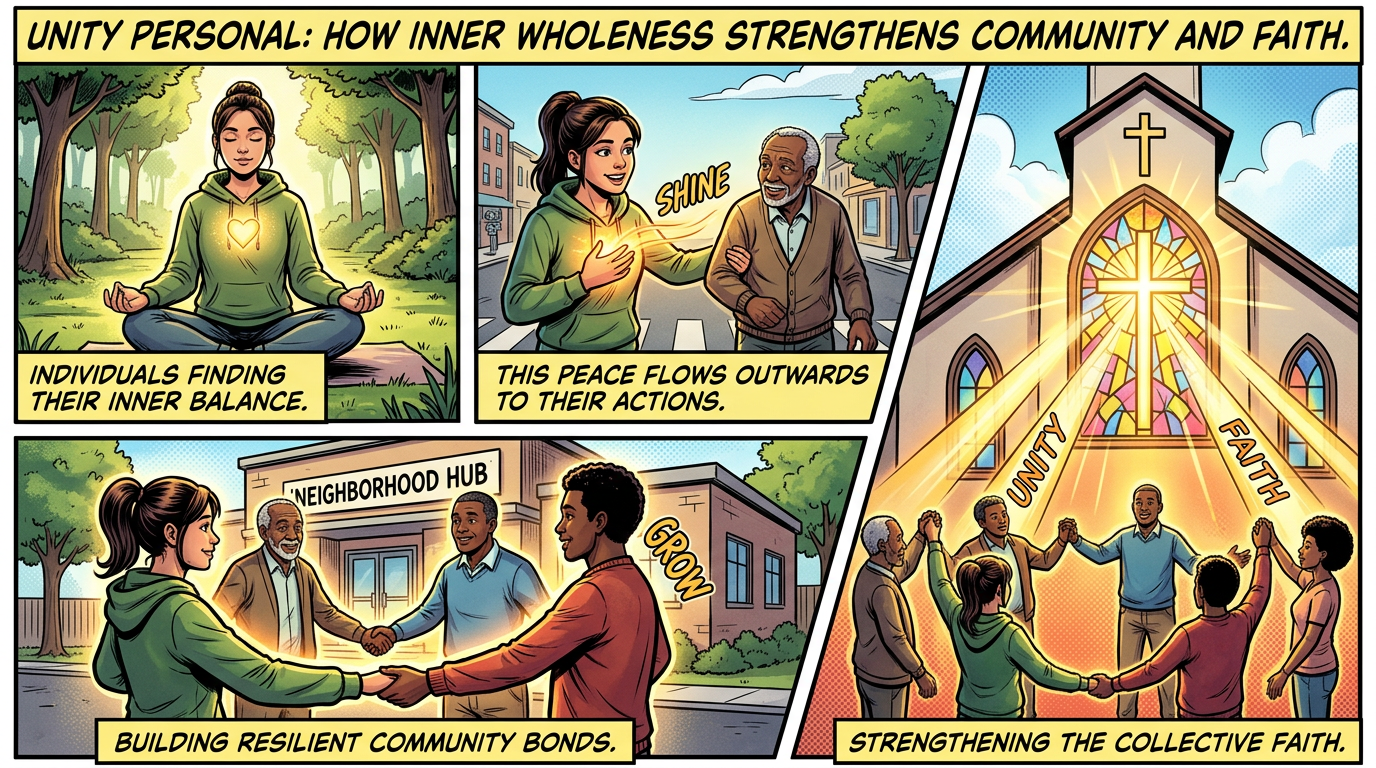
What does unity personal have to do with the strength of a church, family, or neighborhood? More than we often realize. Communal unity does not begin with everyone agreeing on every question. It begins when people learn to live honestly with their beliefs, emotions, conscience, relationships, and daily actions.
Inner wholeness is not personal perfection. It is a growing alignment between what we say we believe and how we actually live. A whole person can admit fear, face failure, seek forgiveness, and choose faithful action without pretending to have everything resolved.
This kind of formation shapes the communities we enter. When we are divided within ourselves, we may become defensive, suspicious, or quick to judge. Without noticing it, we can carry our unresolved pain into conversations about faith and justice. But grounded people bring different gifts: patience under pressure, truthfulness without cruelty, and trust that makes honest dialogue possible.
Consider a disagreement in a small group. One person may speak from conviction, while another listens through the wounds of past rejection. Inner work does not remove the disagreement. It helps each person respond with greater clarity, humility, and care.
This article will explore how personal spiritual growth can strengthen shared life without turning faith into a private project. We will make room for moral disagreement, accountability, and the hard work of reconciliation. Unity does not require uniformity; it requires enough honesty and love to remain connected while seeking what is true.
What Inner Wholeness Means in a Life of Faith
Inner wholeness is not the same as having every part of life under control. In faith, it means bringing our whole selves into relationship with God: mind, body, emotions, conscience, convictions, and daily behavior. Nothing is treated as irrelevant or pushed into a locked room.
Imagine your life as a house with many connected rooms. One room holds your thoughts, another your memories, another your physical life and emotions. Your faith may have its own room, but spiritual maturity invites God into the entire house. What we believe begins to shape how we speak, rest, work, forgive, and take responsibility.
This kind of unity personal does not mean emotional perfection. A whole person can still carry wounds, contradictions, doubts, and limitations. The difference is that these realities are acknowledged rather than hidden behind religious language. We do not need to pretend we are untroubled in order to be faithful.
I once heard someone describe prayer as “opening the curtains” in a room they had avoided for years. That image has stayed with me. God’s presence does not depend on our ability to appear polished. Instead, God’s grace helps us tell the truth about what is there, including grief, anger, fear, and the desire to change.
Healthy inwardness makes this honesty possible. It gives us space to notice our motives, receive God’s mercy, and recognize where healing is needed. Yet inwardness is not the same as individualism. A person who turns inward for wisdom can become more dependent on God and more open to trusted people. A person committed to individualism may resist correction, avoid responsibility, and call isolation freedom.
For this reason, inner wholeness always has a communal dimension. The rooms of our lives are connected, and so are our choices. Unexamined resentment can shape a family conversation; hidden shame can make friendship difficult; unchallenged pride can wound a congregation. Bringing the whole self to God also means allowing others to help us see what we cannot see alone.
Faith does not ask us to become self-sufficient. It teaches us to become truthful, receptive, and responsible. As we receive forgiveness and practice it, our divided lives can become places where redemption is visible—and where unity grows through honesty rather than pretense.
Why Unresolved Inner Division Weakens Community
What we cannot see alone can still shape the way we live together. Fear, shame, resentment, insecurity, and hidden ambition often enter communal life quietly. They influence how we interpret words, respond to disagreement, and decide whom we trust.
A person carrying unexamined fear may become defensive when someone asks a reasonable question. Shame may lead another to hide mistakes, while resentment appears as gossip or passive resistance. Hidden ambition can disguise itself as religious zeal, yet still seek control, recognition, or influence.
These inner divisions do not remain private for long. In congregations, families, service groups, and faith-based communities, they can produce familiar patterns:
- defensiveness instead of listening
- gossip instead of honest conversation
- control instead of shared responsibility
- factionalism instead of fellowship
- moral superiority instead of humility
- avoidance instead of reconciliation
This does not mean every communal conflict begins inside an individual. Sometimes a disagreement reflects a real moral difference or a necessary challenge to injustice. Communities may also suffer from poor leadership, exclusion, harmful traditions, unequal power, or structures that protect some people while silencing others.
Still, personal wounds can intensify these problems. A person who feels threatened by feedback may treat accountability as persecution. Someone unable to tolerate difference may call every question disloyal. Even religiously approved language can become a shield when it prevents apology, curiosity, or honest self-examination.
We have all seen how quickly trust weakens when someone will not admit harm. A leader may speak often about grace but rarely offer it. A family member may praise unity while demanding silence. A volunteer may serve faithfully yet quietly punish anyone who receives recognition. In each case, the public language sounds worthy, but the hidden division shapes the relationship.
Personal wholeness does not make us flawless or remove every disagreement. It helps us recognize what belongs to the present conflict and what belongs to an older wound. This kind of unity personal work allows us to say, “I may be reacting from fear,” or, “I need to understand before I defend myself.”
Such honesty changes the atmosphere around us. It makes room for apology, forgiveness, and wiser boundaries. It also helps communities examine their own habits, so responsibility does not fall only on individuals when healing requires shared courage.
Practices That Cultivate Personal Unity
Personal unity grows through repeated attention, not instant transformation. Prayer can become a daily place to bring our divided thoughts before God. We do not need polished words. We can simply name what is present: “I am afraid,” “I feel resentful,” or “I want to be seen.”
Naming emotions before God often lowers our reactivity. Once fear or anger has been acknowledged, it does not need to control the next conversation. Prayer creates room for compassion, discernment, and responsible action, especially when another person has disappointed us.
Silence offers a similar gift. In a quiet moment, we may notice motives that busyness conceals. Honest self-examination then asks gentle but direct questions: What am I protecting? Where have I caused harm? What truth am I avoiding?
Scripture or another sacred text can help test those answers. Rather than using a passage to confirm our preferences, we can let it challenge our assumptions and enlarge our concern for others. Confession continues this work by turning insight toward responsibility. It names what needs forgiveness and, when possible, repair.
Journaling gives these practices a visible shape. Writing a few lines can reveal patterns across several days: recurring irritation, a neglected need, or a desire that has quietly become an idol. Wise spiritual direction or counseling can offer another perspective. These guides should serve discernment, not replace it. Resources such as the Going My Way. Today website can also support continued reflection between conversations and seasons of prayer.
Personal unity also depends on the body. Rest, healthy boundaries, nourishing food, movement, and attention to physical needs are not distractions from spiritual life. Exhaustion often disguises itself as spiritual urgency. When we slow down, we may discover that our harsh response came from depletion rather than conviction.
A simple rhythm can help unite inner awareness with communal responsibility:
- Notice your inner response without defending it.
- Bring it honestly into prayer.
- Test it against your core values and sacred commitments.
- Choose the most relationally responsible action available.
Perhaps the action is an apology, a pause, a clear boundary, or a patient question. Over time, these small choices shape how we enter community. We become less governed by impulse and more available to listen, forgive, speak truthfully, and remain connected through disagreement. This is unity personal: an inward wholeness that makes outward love more steady.
How Inner Wholeness Changes the Way We Relate to Others
Inner wholeness becomes visible in the way we listen. When we are less threatened by our own complexity, we do not need to defend every weakness or win every conversation. We can hear another person’s concern without treating it as an attack on our identity.
This does not mean becoming passive or agreeable. It means staying present long enough to understand what is being said. Self-knowledge helps us recognize our fears, shame, and longing, so another person’s vulnerability becomes easier to honor rather than dismiss.
Consider a disagreement in a faith community about how to welcome a struggling family. One person reacts quickly, accusing others of abandoning biblical conviction. Another withdraws and says nothing, fearing rejection. Both responses may protect something tender, but neither creates much room for truth or relationship.
An integrated response might sound different: “I feel protective of what we believe, and I also realize I am afraid of getting this wrong. Can we talk about what care and faithfulness require here?” That person has not surrendered conviction. They have made room for humility, listening, and shared discernment.
Inner wholeness also supports both compassion and boundaries. We do not have to choose between people-pleasing and harsh self-protection. We can care about someone’s pain while saying, “I cannot continue this conversation if we are insulting one another,” or, “I am willing to help, but I cannot take responsibility for this decision.”
Accountability becomes steadier, too. A mature apology is specific and does not manipulate the other person into offering comfort. It names the harm plainly, avoids excessive self-condemnation, and is followed by changed behavior: “I interrupted you and dismissed your concern. That was wrong. Next time, I will listen before responding.”
These habits strengthen communal trust because forgiveness is joined with responsibility. In this sense, unity personal is never merely a private feeling of peace. It is the growing ability to remain honest, compassionate, and present when love becomes difficult.
Over time, integrated people help communities become safer without becoming complacent. They can receive correction, offer it with care, and stay connected through disagreement. Their wholeness does not remove conflict; it gives conflict a more truthful and hopeful place to go.
Unity Without Uniformity: Holding Conviction and Difference Together
A healthy faith community does not require everyone to share the same interpretation, culture, or way of practicing faith. Unity can mean shared relationship, purpose, and moral commitments without demanding agreement on every preference or theological nuance. We may worship differently, read a passage differently, or carry different histories while still choosing to love our neighbors and seek the good together.
I have seen this tension in ordinary conversations: one person speaks from a deeply held conviction, while another hears that conviction as a threat. Insecurity can turn belief into control. When our identity feels fragile, we may insist that everyone must think, speak, or practice as we do. Inner wholeness gives us a steadier foundation. We can remain rooted without treating difference as rejection.
This kind of rootedness does not make conviction less meaningful. It allows conviction to be expressed with humility. We can say, “This is what I believe,” while leaving room for another person’s conscience and experience. Charitable interpretation helps us resist the quickest judgment, especially when cultural differences shape how people communicate or worship.
Patient dialogue also requires shared practices. We listen before correcting, ask questions before assigning motives, and return regularly to prayer, service, hospitality, and the care of those who are vulnerable. These practices remind us that community is built through more than discussion. Sometimes disagreement can be explored over time; sometimes it reveals a boundary that must be honored rather than debated endlessly.
The language of unity, however, must never be used to silence people who have been harmed. Calls for peace can preserve unhealthy power when they ask the wounded to remain quiet or forgive without truth, accountability, or change. Authentic unity includes justice. It makes room for honest testimony, responsible boundaries, and the difficult work of naming what has gone wrong.
Inner freedom also changes how we receive another person’s gifts. When we are secure in our own place, someone else’s insight, leadership, culture, or creativity does not diminish us. We can celebrate what they bring without competing for worth. This is unity personal: becoming whole enough to belong without possessing, disagree without contempt, and share a common life without requiring sameness.
From Personal Formation to a Healthier Faith Community
Personal responsibility matters, but no one becomes whole in isolation. Communities shape the conditions where people can tell the truth, receive care, accept accountability, and grow in faith. A person may desire healing, yet a culture of secrecy or fear can make honesty feel dangerous.
Healthy communities build ordinary practices that support integration. Small groups, shared prayer, testimony, mentoring, and service across social boundaries help people be known beyond their public roles. Restorative conversations also teach us that conflict does not have to end belonging. With patience, disagreement can become an invitation to deeper understanding.
Leadership carries particular responsibility. Leaders should model humility by receiving correction, acknowledging their limits, and admitting when they do not know what to do. They must also establish safeguards against manipulation and spiritual abuse. Clear boundaries, shared decision-making, transparent finances, and trusted processes for reporting harm protect both individuals and the community’s witness.
A mature faith community makes room for more than confidence and outward success. There should be space for lament, doubt, grief, unanswered questions, and seasons when prayer feels difficult. In Scripture, faithful people often bring confusion and sorrow directly to God. Their honesty does not weaken faith; it keeps faith connected to reality.
We can often recognize a healthier culture through its everyday patterns:
- People can disagree without humiliation, and repair remains possible after conflict.
- Vulnerable members are protected rather than pressured to perform forgiveness.
- Leaders can be questioned without retaliation or dismissal.
- Service is shared wisely, rather than built on exhaustion and burnout.
- Testimonies include weakness and dependence, not only victory.
These habits require reciprocity. Individuals contribute by speaking truthfully, honoring boundaries, receiving correction, and practicing forgiveness. Communities, in turn, must examine structures that reward silence, protect powerful people, or leave wounded members to heal alone.
I have seen the difference a patient community can make when someone finally says, “I am not sure,” and is met with care instead of suspicion. That response does not solve every problem. It creates enough safety for the next honest sentence, the next faithful step, and the slow work of redemption.
Unity personal becomes communal when inner wholeness meets shared responsibility. We cannot control every culture around us, but we can help form communities where truth and love remain together.
Frequently Asked Questions About Personal Unity, Community, and Faith
Does inner wholeness mean I must resolve every wound before participating in community?
No. Community is not a reward for having a perfectly healed life. Often, honest participation becomes part of healing, especially when trusted people offer patience, truth, and care.
Still, participation requires responsibility. We can name where we are struggling, honor appropriate boundaries, and remain accountable for how our pain affects others. Saying “I am still healing” should invite support, not excuse harm.
Can I be spiritually whole while experiencing doubt, grief, or strong emotions?
Yes. Wholeness does not mean eliminating doubt, sadness, anger, or fear. It means relating to these experiences truthfully and responsibly rather than allowing them to rule us or hiding them behind religious language.
A grieving person may still have faith. Someone asking difficult questions may still be deeply devoted. Inner unity grows when our emotions, beliefs, choices, and relationships are brought into honest conversation rather than forced into premature certainty.
How can I pursue unity when another person or group has caused real harm?
Begin with truth, safety, and justice. Unity must never require denial, silence, or renewed exposure to abuse. Sometimes love means creating distance, involving wise leaders, documenting harm, or seeking professional and legal support.
Reconciliation may become possible in time, but it cannot be demanded from the person who was harmed. Forgiveness can release the desire for revenge while still honoring boundaries and accountability. Redemption does not erase responsibility.
What is the difference between unity and uniformity?
Unity joins people around relationship, shared purpose, and core commitments. Uniformity demands sameness in opinions, personalities, backgrounds, or practices.
A healthy faith community can hold different traditions and perspectives without losing its center. Like a choir, its strength comes from many voices learning to listen and contribute. Unity personal helps us belong without requiring everyone else to become like us.
What is one practical first step toward greater inner wholeness?
Notice one recurring reaction. Perhaps you withdraw from correction, become defensive during disagreement, or seek approval before trusting your own judgment.
Then ask what fear or desire may be beneath it. Bring that discovery into prayer, journaling, or quiet reflection. Finally, discuss it with a trustworthy person who can offer honest feedback without contempt. This small practice creates room for forgiveness, change, and the patient work of becoming whole.
Becoming Whole for the Sake of One Another
Inner wholeness is not a private achievement. It is a way of becoming more available to love, truth, service, repair, and shared faith. When we bring our divided places into honest relationship with God and others, humility, empathy, courage, discernment, and accountability become more available in ordinary moments.
This does not mean we become perfectly calm or consistently wise. It means we notice what shapes our reactions and take responsibility for what we bring into the room. A whole person can pause before speaking, receive correction without collapse, honor a different perspective, or offer an apology without protecting their pride.
Healthy unity is cultivated through repeated choices. We tell the truth, receive grace, honor difference, repair harm, and remain connected to a purpose larger than the self. These choices may seem small, but they gradually create trust. They help communities hold both belonging and responsibility, compassion and conviction.
The hope is not a conflict-free community. Such a promise would ask us to deny the complexity of human life. The deeper hope is a community mature enough to face conflict without surrendering love, and faithful enough to keep seeking redemption when repair takes time.
This is the gift of unity personal: an inner life increasingly gathered toward truth, so our presence can help gather others toward one another. We do not become whole for our own perfection, but for the sake of a shared life.
What part of yourself are you keeping separate from faith or relationship? How might bringing it honestly into the light become a gift to your community?

Leave a Reply