
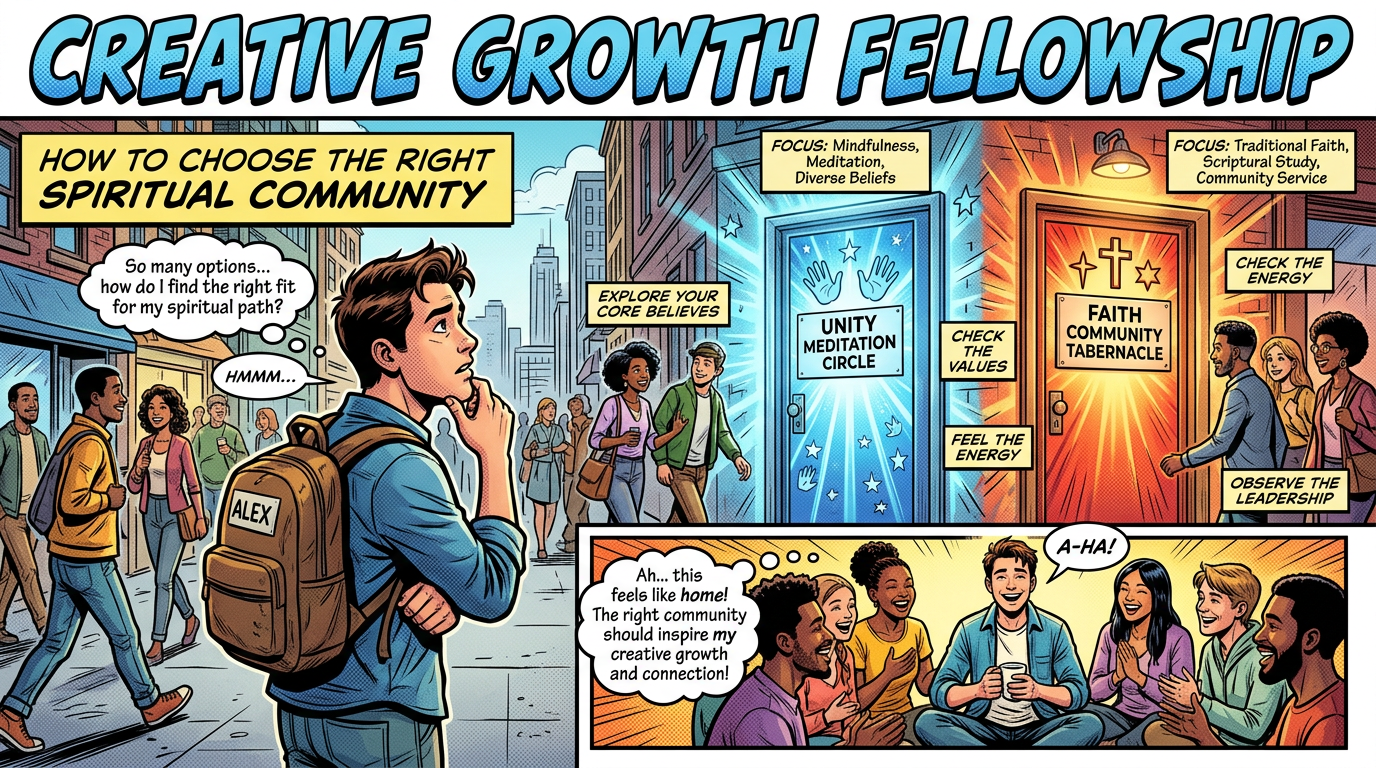
Choosing a spiritual community is rarely as simple as finding the most appealing beliefs, music, or programs. A creative growth fellowship offers a wider lens: it asks whether a community helps people deepen faith, practice creativity, reflect morally, and become more fully themselves.
The right community should do more than inspire you for an hour or provide a welcoming social circle. It should shape conviction and character through honest questions, meaningful relationships, and opportunities to serve. Like a good friend, it should encourage growth while making room for doubt, change, and the unfinished parts of your story.
This kind of discernment takes time. You may need to listen closely to a community’s theology, observe how leaders use authority, and notice whether its culture reflects forgiveness and humility. Practical matters matter, too, including location, time, family needs, accessibility, and the expectations attached to belonging.
Most importantly, pay attention to your own experience. Do you feel invited to grow, or pressured to perform? Are your questions received with patience? In the pages ahead, we will consider how to recognize a spiritual home that supports sincere faith, creative courage, moral reflection, and genuine personal growth.
Begin With the Kind of Growth You Are Seeking
Before comparing spiritual communities, pause to name what you need in this season. Are you seeking deeper faith, moral clarity, contemplative practice, creative expression, accountability, healing, service, or thoughtful discussion? Your answer may not be permanent, but it can help you recognize which invitations deserve your attention.
Sometimes, we need a temporary space for exploration. A discussion group, retreat, or open gathering may offer room to ask questions without making a long-term commitment. At other times, we are searching for a spiritual home where relationships can deepen through shared practices, responsibility, and steady presence.
These goals call for different kinds of structure. A creative growth fellowship might welcome experimentation, artistic work, and honest conversation. Another community may offer a clearer rhythm of worship, study, service, or mentoring. Neither approach is automatically better; the important question is whether its shape supports the growth you are seeking.
It can help to write a few sentences about your hopes before attending. Perhaps you want to reconnect with prayer after a difficult year. Perhaps you are looking for people who will help you live your values, or for companions who can engage difficult ethical questions without easy answers.
A healthy community may challenge you, and that challenge can become a form of love. Still, it should not require you to abandon honest questions or perform certainty you do not feel. Growth rooted in faith and trust leaves room for humility, doubt, forgiveness, and change.
As you visit different fellowships, notice whether their expectations match your present capacity. A community that asks for more time, service, or public commitment may be meaningful later, but overwhelming now. The right fellowship will invite sincere participation while respecting the person you are still becoming.
Examine the Community’s Beliefs and Approach to Spiritual Practice
Once you understand a fellowship’s expectations, look more closely at its beliefs. Begin with its written statement of faith, values, or purpose. Then compare those words with what members actually emphasize in gatherings, conversations, teaching, and decision-making. A community may speak about compassion, for example, while its daily culture centers mostly on certainty or conformity.
The right creative growth fellowship does not require you to abandon your convictions. It should offer shared foundations while leaving room for thoughtful engagement. Notice whether people can discuss faith and morality with honesty, humility, and care. Meaningful agreement matters, but so does the freedom to keep learning.
Ask how the group responds when someone disagrees. What happens when a member expresses doubt, questions an interpretation, or raises a difficult ethical concern? Healthy communities do not treat every uncertainty as rebellion. They make space for patient conversation, changing perspectives, and the possibility that wisdom develops over time.
You might also ask how leaders make decisions. Are difficult choices guided by clear principles, prayer, communal discernment, or the preferences of a few influential voices? Listen for whether the community’s moral framework protects human dignity, welcomes accountability, and makes room for forgiveness and redemption.
Finally, examine the group’s spiritual practices. Prayer, study, worship, meditation, service, and creative work can each deepen a person’s inner life. Yet novelty alone does not make a practice meaningful. Look for depth and consistency: Does worship shape everyday conduct? Does study lead to compassion? Does service honor the people being served?
Your own response matters here, too. You may feel challenged by unfamiliar practices while still sensing integrity beneath them. Give yourself time to discern whether the community’s approach stretches your understanding in a life-giving way or asks you to silence your conscience.
Look Closely at Culture, Leadership, and Relationships
A fellowship’s values become clearest in ordinary interactions. Notice how people greet newcomers, listen to one another, and respond when someone disagrees. In a healthy creative growth fellowship, questions are respected, and participation is not treated as proof of spiritual worth.
You should feel welcomed without being rushed into belonging. Members may invite you to join a gathering or serve in a project, but they will not pressure you to share personal stories, make public commitments, or match their level of involvement. Pay attention to whether people honor your pace and leave room for honest discernment.
Leadership deserves careful attention, too. Look for humility, transparency, moral consistency, and healthy boundaries. Leaders do not need to appear perfect, but they should acknowledge mistakes, welcome accountability, and explain decisions clearly. They guide without demanding unquestioned loyalty, and they do not confuse authority with control.
Some warning signs are easy to overlook when a community feels inspiring at first. Be cautious around secrecy, manipulation, favoritism, and shame-based messages. Pressure to give money, disclose private information, or abandon outside relationships can point to an unhealthy culture. So can a pattern of isolating members from family, friends, or other sources of wisdom.
Also consider who receives patience and belonging. Does the group treat people with different backgrounds, abilities, beliefs, or levels of commitment with genuine respect? Watch how members speak about those who are absent, struggling, or no longer involved. A community’s quality often appears in these quiet moments, when there is nothing to gain by being kind.
As you observe, notice your own body and spirit. Do you become more honest, compassionate, and free to grow? Or do you find yourself managing appearances and fearing disapproval? These responses cannot answer every question, but they can help you recognize whether relationships are leading toward forgiveness and redemption—or toward dependence and fear.
Assess Practical Fit Without Losing Sight of the Larger Purpose
A community’s practical structure can either strengthen fellowship or quietly make participation difficult. Consider meeting frequency, location, online access, schedule, cost, childcare, and accessibility. These details are not distractions from spiritual life; they help determine whether spiritual life can be sustained.
Ask how the community communicates between gatherings. Is information shared clearly and consistently, or do you need insider knowledge to stay connected? Notice whether people can participate through different forms of service or creative contribution, including music, writing, art, hospitality, teaching, or behind-the-scenes work.
It is also wise to clarify expectations before committing. How often are members expected to attend? Is volunteering required, and how are financial giving and shared expenses discussed? Ask about leadership pathways, confidentiality, and the level of personal involvement expected in small groups or pastoral care.
A demanding commitment is not automatically unhealthy. Sometimes a creative growth fellowship asks us to stretch, serve faithfully, and make room for others. The important question is whether that commitment feels life-giving over time, or whether it consistently produces exhaustion, guilt, and pressure.
Pay attention to who the structure seems designed to serve. A fellowship that meets only during work hours may exclude caregivers and shift workers. High costs, limited transportation, inaccessible spaces, or unspoken social rules can favor people with abundant time, money, confidence, or social access.
You might ask, “What would participation require from someone with my responsibilities?” A gracious community will welcome honest questions and explore reasonable accommodations. It will value presence and integrity over performance, making room for seasons when your capacity changes.
The right spiritual home will not demand that you ignore your limits. Instead, it will help you offer your gifts freely, receive support without shame, and remain connected to the larger purposes of love, forgiveness, and redemption.
Visit, Participate, and Discern Before You Commit
Once you have considered a fellowship’s values and expectations, give yourself time to experience its life. A website or warm invitation can offer useful clues, but neither reveals the whole community. Attend more than one gathering before deciding whether this creative growth fellowship is a place where you can belong and become.
When possible, try different formats. Join a worship service, discussion group, study session, service project, or informal fellowship event. Each setting reveals something different. Notice how people listen, share responsibility, welcome newcomers, and make room for honest questions.
Speak with leaders, but also seek out ordinary members. Ask what has helped them grow and how the community handles conflict. You might also ask what they wish they had known before joining. Their answers can reveal whether the fellowship practices forgiveness and accountability, or simply speaks about them.
After each visit, pause before interpreting your first impression. Did you feel more grounded, honest, challenged, and connected? Or did you mainly feel impressed, anxious, pressured, or invisible? A meaningful community may stretch you, but it should not require you to abandon your conscience or perform a version of faith that feels false.
Discernment is rarely a single dramatic moment. Pray, keep a journal, and speak with trusted people who know your hopes and limits. If appropriate, agree to a trial period before taking on public roles or lasting commitments. Choosing slowly is not a lack of commitment; it can be an act of wisdom, humility, and care.
Choose the Community Where Growth Can Become a Shared Practice
No spiritual community will meet every preference. The right one, however, should align with your core convictions, respect your conscience, and encourage steady maturity. It should also make room for meaningful participation, whether through prayer, creative work, service, conversation, or quiet presence.
As you bring these questions together, look for integrity in both teaching and relationships. Can people disagree without losing belonging? Are forgiveness and redemption treated as lived practices, rather than familiar words? A healthy creative growth fellowship helps people become more honest, compassionate, and responsible in daily life.
Remember that discernment takes time. Your capacity may change, and a community should allow growth without demanding performance. The best fellowship will welcome your questions, honor your limits, and invite you to offer your gifts freely.
Choose a spiritual home not for its status or emotional intensity. Choose it for the quality of its character, the strength of its relationships, and its capacity to help people live their values. In such a community, convictions, questions, relationships, and daily practice can grow together—with integrity, patience, and hope.

Leave a Reply